I just received an update from the Nader/Gonzalez webteam and I must say it was bold. In it, they link directly to the DNC asking people to "give them some more money," if you believe they are the solution to an ailing nation. That's pretty ballsy -- typical email fundraising strategy is pretty clear on NOT linking to your competitor's website. Nader's email pretty much just puts it all out there.
Two weeks ago the Nader team called progressive democrats who had supported the pro-war, pro-Patriot Act, anti-labor, and anti-environmental candidate John Kerry in 2004, "shameful" for selling out. Of course, Medea Benjamin responded on the Nader blog (because Medea is never one to shy away from confrontation, be it detrimental to overall campaign goals or not) stating that everyone should respect each other's choices when it comes to supporting a Presidential candidate. Honestly, if I was Medea I would have left this one alone but she has now given fuel to the fire.
Nader's team responded by having Peter Camejo, his running mate in 2004, write an essay about how the Democratic party lost its soul and began simply curtsying to an unchecked Bush administration. Its a good essay and one that I think ties in the larger questions and concerns that many in this country have about the current 2-party political system.
But at the heart of this disagreement between Nader and Benjamin is the question of whether Progressives can change the Democratic Party from the inside out or whether they can force it to move left by flanking it with candidates like Nader and the Green Party. Benjamin, unlike many people I know, has tried both. Kudos to her for understanding the challenges with both strategies. Nader has tried both as well -- though he's only ever run for office independent of both major parties.
Personally, I feel that its easier to change an entrenched system by getting inside and changing it one artery at a time. Rarely do strategies based on outside pressures work, and I would argue that even those strategies included inside efforts that not everyone knew was going on. I agree with Nader that Democrats caved to status-quo assumptions and pressures from Bush and Co. (which is why I worked for Howard Dean in 2004 -- he was about the only public figure against the war in Iraq from day one). I also respect Medea (and many other progressives) who are working on changing the party from the inside the belly of the beast.
One element that bothers me about Medea's strategy is that assumes the system that we are working within (be it for Republicans or Democrats) is sound and efficient. In reality, we have a system that is completely archaic and not serving the people of the country. This is why so many people have disengaged from the political process -- no one has been able to answer the question, "Whats in it for me?" We have two Presidential campaigns that treat voters as consumers and adopt corporate marketing techniques just so they can communicate with them. Instead, we need candidates who can step back and realize the system itself needs to be more than just tinkered with and actually overhauled. Nader understands this but he's too busy telling us what's wrong instead of taking action on real solutions that are occurring all over the country.
I believe that great change starts from the bottom and trickles up. Well organized efforts often started with one person taking action -- be it suffrage or civil rights. All movements start with one person taking a simple but ofttimes powerful action. Medea knows this, and I'm curious to know her thoughts on working within the Democratic Party at the highest levels and whether that is going to be a successful strategy when it comes to creating long-standing, sustainable change in the party and country. Or maybe DC is where you go after working in and around local and state politics for so many years? I certainly hope not. Career politicians are exactly what we need less of in our leadership.
Friday, April 25, 2008

A Real Grocery
I lived in Berkeley for about year in 2005. I got to know parts of Oakland through friends that lived there and events and activities going on around the East Bay. The poverty of West Oakland is real and yet can seem distant and far off when you're being whisked through it on a BART train.
The People's Grocery is in that part of West Oakland where dozens of liquor stores are always two blocks away, multiple fast-food joints are around the corner but the closest grocery store, selling fresh food and vegetables, is a 15 minute drive. The community is depressed. The folks are struggling. The People's Grocery is changing all that.
The People's Grocery is in that part of West Oakland where dozens of liquor stores are always two blocks away, multiple fast-food joints are around the corner but the closest grocery store, selling fresh food and vegetables, is a 15 minute drive. The community is depressed. The folks are struggling. The People's Grocery is changing all that.
Wednesday, April 23, 2008
A Texas-Sized Problem
Some of you may have heard about the garbage patch of the Pacific ocean discovered recently by scientists examining water quality between California and Japan. Its an astounding story of the actual imprint we are leaving on our world and how its coming back to haunt us in more ways then one.
Some folks over at VBS.tv, as part of their Toxic Series, took a 3-week trip with scientists studying the garbage patch and have a brilliant video series documenting their experience.
Here is a part 9 of 12:
"I'm bummed," says Meredith Danluck of VBS TV, "I mean we are in the middle of nowhere, you know, maybe no one has ever been in this spot. And its filled with our trash...we've really screwed up and are all going to hell."
Kudos to Thomas Morton and his crew for this incredible peek into an unknown but devastating problem in the Pacific. Its not heavy on science and instead shows, from a typical American perspective, the impacts on each individual as they deal with the what they're seeing. "There is definitely a shift in understanding going on for the people on this boat..."
"Basically, we've consigned ourselves to eating our own shit. We've been tossing out plastic for years and its come back to bite us back in the ass already."
What's incredible about this video series is that it unearths a deeper problem in our society concerning not just how we dispose of waste but the real threat of unchecked production of plastics and those effects on our health. I am continually amazed at how little connection is drawn between cancers and other illnesses and the environmental devastation going on worldwide. Morton and VBS make a pretty air-tight argument for why we need to rethink the entire system before it really is too late.
Also, VBS has a similar series on the Tar Sands of Alberta that is incredibly well done. My former organization, Rainforest Action Network, has been working on this issue for over two years now. Check it out.
Oh, and the soundtrack with indie band Brighton, MA is ideal for the mood of the film.
Some folks over at VBS.tv, as part of their Toxic Series, took a 3-week trip with scientists studying the garbage patch and have a brilliant video series documenting their experience.
Here is a part 9 of 12:
"I'm bummed," says Meredith Danluck of VBS TV, "I mean we are in the middle of nowhere, you know, maybe no one has ever been in this spot. And its filled with our trash...we've really screwed up and are all going to hell."
Kudos to Thomas Morton and his crew for this incredible peek into an unknown but devastating problem in the Pacific. Its not heavy on science and instead shows, from a typical American perspective, the impacts on each individual as they deal with the what they're seeing. "There is definitely a shift in understanding going on for the people on this boat..."
"Basically, we've consigned ourselves to eating our own shit. We've been tossing out plastic for years and its come back to bite us back in the ass already."
What's incredible about this video series is that it unearths a deeper problem in our society concerning not just how we dispose of waste but the real threat of unchecked production of plastics and those effects on our health. I am continually amazed at how little connection is drawn between cancers and other illnesses and the environmental devastation going on worldwide. Morton and VBS make a pretty air-tight argument for why we need to rethink the entire system before it really is too late.
Also, VBS has a similar series on the Tar Sands of Alberta that is incredibly well done. My former organization, Rainforest Action Network, has been working on this issue for over two years now. Check it out.
Oh, and the soundtrack with indie band Brighton, MA is ideal for the mood of the film.
Friday, April 18, 2008
EdWords
This guy is amazing. I'm sad his outstanding platform is being buried by Obama and Hillary bickering about who's more bitter. At least this guy keeps his eyes on the prize when it comes to fighting for universal healthcare, solving poverty and the working and middle class of America.
Thursday, April 10, 2008
China, the Olympics and Tibet
I've heard some interesting arguments over the past two days on why we should allow China to host the Olympic Summer Games in a few months, effectively ignoring their human rights record. I thought I'd address some of them here:
"We shouldn't make the Olympics political"
It's easy not to make the Olympics political when the host country isn't guilty of human rights abuses. It's easy when the host country is becoming the world's largest consumer society. But, at its heart, Olympism is not about politics. Its about showing the universality of common good and ethics. Human rights abuses are happening everyday all around the world. Its an unfortunate fact. The difference here is that the world has chosen to reward a country, guilty of oppression and cultural assassination, with an international commendation (The Olympic Games). This is not what the Olympics were founded on and challenging this type of political and cultural oppression is actually elemental to the Olympic spirit. From the Olympic Charter:
Principle #2:
China is hardly advocating the "harmonious development of man," nor are they "promoting a peaceful society concerned with the preservation of human dignity." If they were, you wouldn't be seeing so many people in the streets. And if they were, the Dalai Llama wouldn't have been exiled to a foreign country after thousands of years living in Tibet. That the International Olympic Committee is permitting China to host the Olympic Games this summer actually goes against its own principles.
Principle #5
It's nice that the Olympic Charter stands against discrimination when it comes to sports, but what about religion and free speech and a free press in one's own country? This is a contradiction if the IOC chooses to ignore the political state of the countries involved in this display of "harmonious development of man." What would the IOC do if Rwanda or Somalia were to host this summer's games?
The Role of the International Olympic Committee: Under the mission and role of IOC, articles 4, 5 and 6:
I would argue that Chinese abuse of human rights (even rumors of such actions in Tibet and other parts of their country) is enough of an argument to show that China has broken their commitment to the IOC and, as a member, should be investigated or temporarily barred from the IOC and therefore not eligible to host the Summer Games in 2008. The Olympics in China, if they are held, are not promoting peace and will not serve humanity when hosted by a country that has avoided international investigation around human rights and political freedoms. #4 speaks directly to the unity that the IOC loves to talk about but fails to activate when tenuous issues arise. Never has the IOC suggested dropping the Olympic Games during these moments - Germany in 1936, Moscow in 1980 - instead, the effort was led by other coalitions of countries.
#10:
This one seems pretty self-explanatory. If I'm a Tibetan distance runner and I am forced to where China's flag when I don't identify as Chinese, shouldn't the IOC advocate and support the athlete?
#13:
This is less about the athletes and more about the history of Chinese environmental degradation. If the IOC were serious about this commitment they would demand China make much more significant reforms in cleaning up the air and water for the world's top athletes.
"The protests were violent"
This is, as always, relative. Some people might call the Iraq War violent, and they would be right. These protests were not that...at all. The most dramatic moments were when non-violent protesters were forcibly removed from blocking streets. There were many heated debates, screaming advocates on both sides of the issue. But not violence. However, I would argue that police used some violent tactics to "remove" these folks, including myself. I don't mind being dragged (I actually expect it as I'm not a small person to carry) but being punched was something I had to raise an eyebrow at. The police are people too, and are just as susceptible to emotional reactions resulting in "violence." I understand that -- and being yelled at and even pushed (hard) by police is not surprising in these situations. The problem is, they're the ones carrying guns, billy clubs, cuffs, zip-ties and wearing helmets, so the balance of power is clearly in their hands, not those protesting. And when a policeman drags you to the curb, puts a knee in your kidney and then picks you up by the collar and throws you into the curb, its ironic to remember that you are the one paying their salaries. "Hey Sergeant, that was well done! I'll be sure to tell the chief to give you that holiday bonus this year. You got an extra band-aid?"
These protests were hardly violent. If the media and those looking to blame free-speech for "their day in the sun" want to push that story, its extremely unfortunate. If anything, the response from the police and security force was violent, not the protesters.
"Protesting the torch is an insult to the rest of the world community"
I have a hard time believing that any type of free-speech is an insult to the world. After all, thats what this country was founded on and is what western democracies and governments are most proud of: our freedom organize and speak freely. The Boston tea party was called an insult to the world by the British sympathizers in the colonies during the beginnings of the American Revolution in 1773. Now, here sit the very same status-quo members of society shaking their heads at protests that are more than (imagine this) standing still with a sign. Martin Luther King didn't stand still. Susan B. Anthony didn't drop her sign when heads shook. Neither should we.
At the heart of this comment, though, is the belief that some things just shouldn't be politicized. But the problem with that perspective is that no "thing" cannot avoid politics. Its ingrained in our lives and cultures and is a part of everything we do. You could argue that schools shouldn't be political, but we know that some of the most fiercely debated issues occur in PTA and school board meetings every week. More importantly, it isn't bad! Politics and discussion isn't going to hurt us and if anything we need more of it not less. Protests like this one, bringing to light the issue of Tibetan freedom and right to exist without Chinese domination, are simply there to elevate the discussion and bring it to the forefront of the international conversation. And clearly, a discussion needs to be had -- from Paris to London to San Francisco and Beijing.
Heres to hoping for an honest discussion and challenging the assumed status of Olympic Games in a country that ignores human rights and freedoms that we say we fight for.
"We shouldn't make the Olympics political"
It's easy not to make the Olympics political when the host country isn't guilty of human rights abuses. It's easy when the host country is becoming the world's largest consumer society. But, at its heart, Olympism is not about politics. Its about showing the universality of common good and ethics. Human rights abuses are happening everyday all around the world. Its an unfortunate fact. The difference here is that the world has chosen to reward a country, guilty of oppression and cultural assassination, with an international commendation (The Olympic Games). This is not what the Olympics were founded on and challenging this type of political and cultural oppression is actually elemental to the Olympic spirit. From the Olympic Charter:
"Olympism is a philosophy of life, exalting and combining in a balanced whole the qualities of body, will and mind. Blending sport with culture and education, Olympism seeks to create a way of life based on the joy found in effort, the educational value of good example and respect for universal fundamental ethical principles."Last I checked, human rights are a fundamentally ethical principle that we all agree on, and one that we have to continually enforce.
Principle #2:
The goal of Olympism is to place sport at the service of the harmonious development of man, with a view to promoting a peaceful society concerned with the preservation of human dignity.
China is hardly advocating the "harmonious development of man," nor are they "promoting a peaceful society concerned with the preservation of human dignity." If they were, you wouldn't be seeing so many people in the streets. And if they were, the Dalai Llama wouldn't have been exiled to a foreign country after thousands of years living in Tibet. That the International Olympic Committee is permitting China to host the Olympic Games this summer actually goes against its own principles.
Principle #5
Any form of discrimination with regard to a country or a person on grounds of race, religion, politics, gender or otherwise is incompatible with belonging to the Olympic Movement.
It's nice that the Olympic Charter stands against discrimination when it comes to sports, but what about religion and free speech and a free press in one's own country? This is a contradiction if the IOC chooses to ignore the political state of the countries involved in this display of "harmonious development of man." What would the IOC do if Rwanda or Somalia were to host this summer's games?
The Role of the International Olympic Committee: Under the mission and role of IOC, articles 4, 5 and 6:
4. to cooperate with the competent public or private organisations and authorities in the endeavour to place sport at the service of humanity and thereby to promote peace;
5. to take action in order to strengthen the unity and to protect the independence of the Olympic Movement;
6. to act against any form of discrimination affecting the Olympic Movement;
I would argue that Chinese abuse of human rights (even rumors of such actions in Tibet and other parts of their country) is enough of an argument to show that China has broken their commitment to the IOC and, as a member, should be investigated or temporarily barred from the IOC and therefore not eligible to host the Summer Games in 2008. The Olympics in China, if they are held, are not promoting peace and will not serve humanity when hosted by a country that has avoided international investigation around human rights and political freedoms. #4 speaks directly to the unity that the IOC loves to talk about but fails to activate when tenuous issues arise. Never has the IOC suggested dropping the Olympic Games during these moments - Germany in 1936, Moscow in 1980 - instead, the effort was led by other coalitions of countries.
#10:
to oppose any political or commercial abuse of sport and athletes;
This one seems pretty self-explanatory. If I'm a Tibetan distance runner and I am forced to where China's flag when I don't identify as Chinese, shouldn't the IOC advocate and support the athlete?
#13:
to encourage and support a responsible concern for environmental issues, to promote sustainable development in sport and to require that the Olympic Games are held accordingly;
This is less about the athletes and more about the history of Chinese environmental degradation. If the IOC were serious about this commitment they would demand China make much more significant reforms in cleaning up the air and water for the world's top athletes.
"The protests were violent"
This is, as always, relative. Some people might call the Iraq War violent, and they would be right. These protests were not that...at all. The most dramatic moments were when non-violent protesters were forcibly removed from blocking streets. There were many heated debates, screaming advocates on both sides of the issue. But not violence. However, I would argue that police used some violent tactics to "remove" these folks, including myself. I don't mind being dragged (I actually expect it as I'm not a small person to carry) but being punched was something I had to raise an eyebrow at. The police are people too, and are just as susceptible to emotional reactions resulting in "violence." I understand that -- and being yelled at and even pushed (hard) by police is not surprising in these situations. The problem is, they're the ones carrying guns, billy clubs, cuffs, zip-ties and wearing helmets, so the balance of power is clearly in their hands, not those protesting. And when a policeman drags you to the curb, puts a knee in your kidney and then picks you up by the collar and throws you into the curb, its ironic to remember that you are the one paying their salaries. "Hey Sergeant, that was well done! I'll be sure to tell the chief to give you that holiday bonus this year. You got an extra band-aid?"
These protests were hardly violent. If the media and those looking to blame free-speech for "their day in the sun" want to push that story, its extremely unfortunate. If anything, the response from the police and security force was violent, not the protesters.
"Protesting the torch is an insult to the rest of the world community"
I have a hard time believing that any type of free-speech is an insult to the world. After all, thats what this country was founded on and is what western democracies and governments are most proud of: our freedom organize and speak freely. The Boston tea party was called an insult to the world by the British sympathizers in the colonies during the beginnings of the American Revolution in 1773. Now, here sit the very same status-quo members of society shaking their heads at protests that are more than (imagine this) standing still with a sign. Martin Luther King didn't stand still. Susan B. Anthony didn't drop her sign when heads shook. Neither should we.
At the heart of this comment, though, is the belief that some things just shouldn't be politicized. But the problem with that perspective is that no "thing" cannot avoid politics. Its ingrained in our lives and cultures and is a part of everything we do. You could argue that schools shouldn't be political, but we know that some of the most fiercely debated issues occur in PTA and school board meetings every week. More importantly, it isn't bad! Politics and discussion isn't going to hurt us and if anything we need more of it not less. Protests like this one, bringing to light the issue of Tibetan freedom and right to exist without Chinese domination, are simply there to elevate the discussion and bring it to the forefront of the international conversation. And clearly, a discussion needs to be had -- from Paris to London to San Francisco and Beijing.
Heres to hoping for an honest discussion and challenging the assumed status of Olympic Games in a country that ignores human rights and freedoms that we say we fight for.
Wednesday, April 09, 2008
Parade of the Vanishing Torch
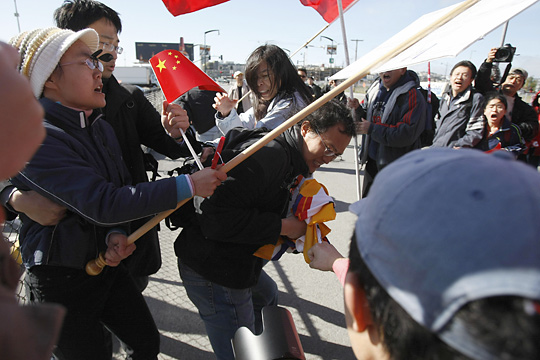
Just got back from a long day chasing the "disappearing torch" across San Francisco. There were over 6,000 protesters that turned out and about as many ethnic Chinese countering. It was a victory for those of us involved in shedding more international attention and light on the human rights abuses China has committed, without any real consequence, over the past half-century in Tibet. The BBC Radio called it "The Parade of the Disappearing Torch," while the Toronto Globe and Mail called it a "hasty tour."
In the end it was just that. Going to elaborate lengths to make sure as few people actually saw the torch as possible, San Francisco city officials were, in the end, unable to avoid protesters who were in constant communication via text messaging and able to re-deploy along the last-minute altered route.
I myself was lucky enough to be part of a team of people trying to hang banners along the parade route that would visually support the protests going on at street level. Thanks to a crackerjack Communications team we were all informed of changes to the route and quickly figured out how to get back along the buses carrying the torch.
Here are some quick observations from the day:
- There were as many if not more China supporters as Tibet supporters.
- There were an amazing amount of extra-large Chinese flags flown in just for the event. Regardless, the impact of hundreds of large, bright red flags aligning the parade route had a visual impact that is hard to beat. Classic Communist tactic?
- Once the parade route changed, the "non-partisan" crowd thinned dramatically. Thousands were left stranded along the original route by the Embarcadero.
- Police presence was overwhelming especially close to the torch.
- Media was in the dark -- most had no idea where the torch was or were jockeying to catchup. This is why I think you will not see a lot of pictures or video of most of the actions taken by protesters.
- One runner dropped out two days before the parade, and another pulled a Tibetan flag out of her shirt-sleeve as she handed off the torch but was quickly grabbed by police and Chinese officials before being shoved back into the crowd.
Overall, I was amazed at some media had chosen to paint a rosy picture of the day's events. I was even more amazed at how incredibly, flat out wrong other new stories were. It made me wonder if they were being written by someone actually in San Francisco or by someone back in London or New York.
I was part of a group of about 10 people that tried to stop the torch caravan (which included about 50 riot police, 30-40 police on dirt bikes, two buses, 4-6 motorcycles from the SFPD and a whole host of police cars and unmarked vehicles). We were able to slow it down and deploy ourselves and a banner across the width of a four-lane street but were "absorbed" by a flock of police in a matter of seconds. No arrests were made but trust me when I say we were all kicked to the curb, that that's exactly what the SFPD did. I'm guessing that most of these officers were not trained in negotiation tactics (unless by negotiate you mean bruise and pummel). I'd like to know if I can trade in my brand new grated elbows and torn clothes for the ridiculous parking tickets SFPD LOVES to hand out.
Here is a decent video of what was happening on the ground. More on this later...
Monday, April 07, 2008
Bomb It
"This is the biggest art movement in the history of human kind." I bet you don't know what the medium is.
"Bomb It," the new documentary about the rise of the graffiti movement in urban regions throughout the world, shows the explosion of underground "tagging" as both an art, and a form of communication (some would argue that any art is a form of communication, which I would agree with). Be it Barcelona, New York, Jo'burg, Berlin or Chicago, this movement has gone way beyond the cultural name-tags ascribed to it years ago yet is still true to its roots. Nor is it dominated by criminals, drug addicts, or delinquents. The artists are legitimate and their work is magnificent.
While I do question the painting of personal property (like cars and homes) I agree that the public space available for this type of art is actually extremely limited since so much of public space is actually reserved for advertising (sides of public buses, highways, etc). So, like any American people are taking it back. I don't blame them.
On a whim, I actually caught one of the original graffiti culture/ hip-hop flicks from 1983 called "Wild Style" last weekend. It should be fun to do a comparison of the two after seeing Bomb It.
I'll be checking it out this weekend and maybe you will too.
"Bomb It," the new documentary about the rise of the graffiti movement in urban regions throughout the world, shows the explosion of underground "tagging" as both an art, and a form of communication (some would argue that any art is a form of communication, which I would agree with). Be it Barcelona, New York, Jo'burg, Berlin or Chicago, this movement has gone way beyond the cultural name-tags ascribed to it years ago yet is still true to its roots. Nor is it dominated by criminals, drug addicts, or delinquents. The artists are legitimate and their work is magnificent.
While I do question the painting of personal property (like cars and homes) I agree that the public space available for this type of art is actually extremely limited since so much of public space is actually reserved for advertising (sides of public buses, highways, etc). So, like any American people are taking it back. I don't blame them.
On a whim, I actually caught one of the original graffiti culture/ hip-hop flicks from 1983 called "Wild Style" last weekend. It should be fun to do a comparison of the two after seeing Bomb It.
I'll be checking it out this weekend and maybe you will too.
Friday, April 04, 2008
40th Anniversary of MLK Memphis Speech
The last two minutes of Dr. Martin Luther King's are shockingly prescient. An incredibly powerful speech that is always good to go back to periodically. He was assassinated hours after this address.
Monday, March 31, 2008
Securing the torch
The world's attention has been on the tiny mountain kingdom of Tibet over the past two weeks after protests in 6 different Chinese cities erupted over the course of several days beginning on March 14. However, China, in the midst of working to downplay and even blame the protests and violence on Tibetan "revolutionaries"", is pushing through to start the Olympic Games of 2008 in Beijing by launching the traditional torch ceremony this morning. Granted security was tight, this didn't stop numerous other protests from re-igniting throughout the region.
China continues to dig itself deeper into a hole lacking any integrity by holding fast to the blame game -- that the Dalai Lama and his supporters instigated the riots and violence that followed the March 14th protests. China should know now that the world won't believe their bureaucratic spin on a situation that has clearly gotten out of hand. Also, does Hu Jintao and the Chinese Communist Party leadership really want to get into a "he said, we said" battle with perhaps the most revered living religious leader on the planet? Its not a battle they can win but I don't see them backing down, even against strong international pressure. Yet eyes widened at yesterday's news that German Chancellor Angela Merkel would not be attending the opening ceremonies of the games because of the Chinese crackdown in Tibet has started a flurry of rumors that other EU leaders (Sarkozy) would follow suit. Merkel became the third world leader (joining Poland's PM Donald Tusk and the Czech Republic's President Vaclav Klaus) to abandon the highly regarded opening ceremonies.
The U.S.'s role in this has been minimal. On the ground activists from Students for Free Tibet (who have been doing a splendid job of communicating information, organizing people on multiple continents and adopting a successful argument for this opportunity and moment) continue to drive energy for the boycott of the Beijing Games. But this is almost an impossible outcome, barring some foreign policy disaster on the part of Jintao's government.
First - the Olympic Games were structured around the idea of putting aside politics, war, and differences to come together to compete. As long as the American Olympic Committee decides not to let politics (read "human rights abuses") interfere with the games, America will be in Beijing for the 2008 Winter Games.
Second - the current American leadership lacks the understanding of what a boycott on behalf of Tibet could accomplish. The last Olympic Games that the U.S. sat out of was in Moscow 1980. Jimmy Carter had specific reasons for the boycott, least of which was the recent Soviet invasion of Afghanistan. Carter understood the impact of such a boycott on the Soviet image and worked overtime to get more than 60 nations to join the U.S. in abstaining from the games. That sent a message to the Soviet leadership. But today's American top-dogs aren't very good away from the doghouse and would never be able to see the benefit in moving China into discussions with Tibet.
Third - corporate America has too much invested in the Olympic Games. This is one of the few moments every decade when these companies have the entire world's eyes and ears -- there isn't anyway they're going to forego that opportunity. And if the U.S. pulls all of its athletes out many of those corporate contracts would fall apart. Combine NBC Sports, AT&T, General Electric, Coca-Cola and others.
Lastly - China currently holds over $1.5 trillion in U.S. debt. Even if Bush could build an argument for why China should begin open talks with Tibet, he would have very little political power with that much debt in one nation's hands. All they would have to threaten to do is flood the market, stop buying our debt and dump our dollars sending our economy into an absolute tailspin. We have very little leverage with the Chinese at this point.
If a protest of these companies were to occur, a U.S. pullout might be more conceivable. But right now, China is just hoping that Olympic Torch gets back to Beijing as quickly as possible, without any major incidents. I, for one, wouldn't mind seeing it be snuffed out in a country where human rights is still an idea, not a practice.
China continues to dig itself deeper into a hole lacking any integrity by holding fast to the blame game -- that the Dalai Lama and his supporters instigated the riots and violence that followed the March 14th protests. China should know now that the world won't believe their bureaucratic spin on a situation that has clearly gotten out of hand. Also, does Hu Jintao and the Chinese Communist Party leadership really want to get into a "he said, we said" battle with perhaps the most revered living religious leader on the planet? Its not a battle they can win but I don't see them backing down, even against strong international pressure. Yet eyes widened at yesterday's news that German Chancellor Angela Merkel would not be attending the opening ceremonies of the games because of the Chinese crackdown in Tibet has started a flurry of rumors that other EU leaders (Sarkozy) would follow suit. Merkel became the third world leader (joining Poland's PM Donald Tusk and the Czech Republic's President Vaclav Klaus) to abandon the highly regarded opening ceremonies.
The U.S.'s role in this has been minimal. On the ground activists from Students for Free Tibet (who have been doing a splendid job of communicating information, organizing people on multiple continents and adopting a successful argument for this opportunity and moment) continue to drive energy for the boycott of the Beijing Games. But this is almost an impossible outcome, barring some foreign policy disaster on the part of Jintao's government.
First - the Olympic Games were structured around the idea of putting aside politics, war, and differences to come together to compete. As long as the American Olympic Committee decides not to let politics (read "human rights abuses") interfere with the games, America will be in Beijing for the 2008 Winter Games.
Second - the current American leadership lacks the understanding of what a boycott on behalf of Tibet could accomplish. The last Olympic Games that the U.S. sat out of was in Moscow 1980. Jimmy Carter had specific reasons for the boycott, least of which was the recent Soviet invasion of Afghanistan. Carter understood the impact of such a boycott on the Soviet image and worked overtime to get more than 60 nations to join the U.S. in abstaining from the games. That sent a message to the Soviet leadership. But today's American top-dogs aren't very good away from the doghouse and would never be able to see the benefit in moving China into discussions with Tibet.
Third - corporate America has too much invested in the Olympic Games. This is one of the few moments every decade when these companies have the entire world's eyes and ears -- there isn't anyway they're going to forego that opportunity. And if the U.S. pulls all of its athletes out many of those corporate contracts would fall apart. Combine NBC Sports, AT&T, General Electric, Coca-Cola and others.
Lastly - China currently holds over $1.5 trillion in U.S. debt. Even if Bush could build an argument for why China should begin open talks with Tibet, he would have very little political power with that much debt in one nation's hands. All they would have to threaten to do is flood the market, stop buying our debt and dump our dollars sending our economy into an absolute tailspin. We have very little leverage with the Chinese at this point.
If a protest of these companies were to occur, a U.S. pullout might be more conceivable. But right now, China is just hoping that Olympic Torch gets back to Beijing as quickly as possible, without any major incidents. I, for one, wouldn't mind seeing it be snuffed out in a country where human rights is still an idea, not a practice.
Friday, March 28, 2008
Body of War
Early this week we passed the 4,000 death mark in the Iraq War. I've had the war on the brain recently, being more amazed at how out of touch most of America is when it comes to recognizing the fact that we're still over there in a big way.
Last October I was lucky enough to catch an amazing documentary called Body of War. Perhaps the most compelling and heart-wrenching glimpse into the life of a young Iraq War Veteran, paralyzed from the chest down, and his treatment upon coming back from Iraq with an near-fatal injury.
Now, Tomas Young, the 25 year-old young man permanently bound to a wheel-chair, has produced an incredible album of all the music that got him to Baghdad, got him through Baghdad and brought him home from Baghdad. The album features original scores from Pearl Jam's Eddie Vedder (who did the entire film soundtrack), Neil Young, Bruce Springsteen, Tori Amos, Ben Harper and Tom Waits. But it doesn't just feature the usual Hollywood liberal elite -- it also features new music from Laura Cantrell, The Nightwatchman, Dialated Peoples and Talib Kweli. Honestly, its one of the better musical mixes I've heard, all the more compelling knowing what each song represents for a man who gave so much for this country. I'd say we owe him, at least, a listen to his album.
I encourage everyone to check out the movie and buy the album:
http://www.bodyofwarmusic.com/
Its also available on iTunes.
Eddie Vedder is also doing a solo tour featuring the music of this album.
And an interesting piece from the Politico on why the anti-war music scene is just not what it was in 1969 (of course, numerous reasons for this, none of which the Politico really pins down).
Last October I was lucky enough to catch an amazing documentary called Body of War. Perhaps the most compelling and heart-wrenching glimpse into the life of a young Iraq War Veteran, paralyzed from the chest down, and his treatment upon coming back from Iraq with an near-fatal injury.
Now, Tomas Young, the 25 year-old young man permanently bound to a wheel-chair, has produced an incredible album of all the music that got him to Baghdad, got him through Baghdad and brought him home from Baghdad. The album features original scores from Pearl Jam's Eddie Vedder (who did the entire film soundtrack), Neil Young, Bruce Springsteen, Tori Amos, Ben Harper and Tom Waits. But it doesn't just feature the usual Hollywood liberal elite -- it also features new music from Laura Cantrell, The Nightwatchman, Dialated Peoples and Talib Kweli. Honestly, its one of the better musical mixes I've heard, all the more compelling knowing what each song represents for a man who gave so much for this country. I'd say we owe him, at least, a listen to his album.
I encourage everyone to check out the movie and buy the album:
http://www.bodyofwarmusic.com/
Its also available on iTunes.
Eddie Vedder is also doing a solo tour featuring the music of this album.
And an interesting piece from the Politico on why the anti-war music scene is just not what it was in 1969 (of course, numerous reasons for this, none of which the Politico really pins down).
Thursday, March 20, 2008
NCAA
It's Day 1 of March Madness and I've got my eyes tracking all my picks online. It should be a ridiculously good tournament and I'm hoping for a couple upsets (come on Siena!).
However, my favorite clip from the past decade of NCAA tournament upsets, because I'm from Vermont and will always root for the Catamounts if they are in it (not this year), is from 2005 when TJ Sorrentine "hit one from the parking lot" in OT to beat the Syracuse Organge and advance to the next round. I think I almost threw the remote control in the bay when I saw this.
But everyone has their favorite buzzer-beater upset moment of the past half-century. If you so, let's hear it.
However, my favorite clip from the past decade of NCAA tournament upsets, because I'm from Vermont and will always root for the Catamounts if they are in it (not this year), is from 2005 when TJ Sorrentine "hit one from the parking lot" in OT to beat the Syracuse Organge and advance to the next round. I think I almost threw the remote control in the bay when I saw this.
But everyone has their favorite buzzer-beater upset moment of the past half-century. If you so, let's hear it.
Sunday, March 09, 2008
Time is Money and Mo' Money = Mo' Problems
I talked with my mother this evening about the lack of focus my generation seems to have when it comes to concentrating on one task for more than ten minutes. Multi-tasking is the new black, and for this generation, the first to have cell phones, email, instant messaging, Facebook, Myspace and text messaging all at once the opportunity to continue a conversation is omnipresent. And the temptation to take on a new one is hard to resist.
The larger issue behind multi-tasking is one of time and the perception each of us have when pressed to complete a task. When we have many tasks to complete at once the urgency increases resulting in stress.
One of our Founding Fathers, Benjamin Franklin, coined the phrase "time is money" in an effort to inspire hard work and efficient business in colonial France as well as institute daylight savings time. Stefan Klein writes in the NY Times about the perceived loss of money that occurs when we are unable to complete a task. This perception is uniquely American and while responsible for the inherent drive in the hard-working, one-week of vacation a year laborer is also responsible for a lot of the stress that goes along with getting ahead or being successful.
Not only do we spend more time switching between tasks we believe are more important but we absorb the stress this multi-tasking creates.
Is our perception of time the key to handling stress and our to-do lists? Stressful moments have been compared to adrenaline rushes in the chemicalization they cause in our physiology. Dr.Eagleman has been studying the effects of time perception in adrenaline situations for years and recently filmed a study. The results are interesting.
Stress is ultimately a trick of the brain. Its a chemical reaction caused by a fear of not completing the task, or getting out of a situation. So we begin to scratch at the walls and desperately look for an exit, what Klein says is our "fight or flight" instinct. In the end, staying focused on one task and following it through to the end is what will most quickly alleviate the stress or pressure. Obviously, this is not always true in all situations as there are times when knowing when to switch to a more urgent task is a ideal and can pay off.
Multi-tasking isn't so much a gut reaction to the adrenaline felt when numerous to-dos are due as it is an opportunity to focus specifically on one task and complete it well.
The larger issue behind multi-tasking is one of time and the perception each of us have when pressed to complete a task. When we have many tasks to complete at once the urgency increases resulting in stress.
One of our Founding Fathers, Benjamin Franklin, coined the phrase "time is money" in an effort to inspire hard work and efficient business in colonial France as well as institute daylight savings time. Stefan Klein writes in the NY Times about the perceived loss of money that occurs when we are unable to complete a task. This perception is uniquely American and while responsible for the inherent drive in the hard-working, one-week of vacation a year laborer is also responsible for a lot of the stress that goes along with getting ahead or being successful.
Believing time is money to lose, we perceive our shortage of time as stressful. Thus, our fight-or-flight instinct is engaged, and the regions of the brain we use to calmly and sensibly plan our time get switched off. We become fidgety, erratic and rash.
Tasks take longer. We make mistakes — which take still more time to iron out. Who among us has not been locked out of an apartment or lost a wallet when in a great hurry? The perceived lack of time becomes real: We are not stressed because we have no time, but rather, we have no time because we are stressed.
Studies have shown the alarming extent of the problem: office workers are no longer able to stay focused on one specific task for more than about three minutes, which means a great loss of productivity. The misguided notion that time is money actually costs us money.
Not only do we spend more time switching between tasks we believe are more important but we absorb the stress this multi-tasking creates.
Is our perception of time the key to handling stress and our to-do lists? Stressful moments have been compared to adrenaline rushes in the chemicalization they cause in our physiology. Dr.Eagleman has been studying the effects of time perception in adrenaline situations for years and recently filmed a study. The results are interesting.
Stress is ultimately a trick of the brain. Its a chemical reaction caused by a fear of not completing the task, or getting out of a situation. So we begin to scratch at the walls and desperately look for an exit, what Klein says is our "fight or flight" instinct. In the end, staying focused on one task and following it through to the end is what will most quickly alleviate the stress or pressure. Obviously, this is not always true in all situations as there are times when knowing when to switch to a more urgent task is a ideal and can pay off.
Multi-tasking isn't so much a gut reaction to the adrenaline felt when numerous to-dos are due as it is an opportunity to focus specifically on one task and complete it well.
Friday, March 07, 2008
Mowing Green

This is just freakin' awesome. If I had a lawn, I'd get one in a heartbeat. A true zero-emissions mower! Albeit, a tad pricey.
Powerless
Senior Foreign Policy adviser and long-time friend to Senator Barack Obama, Samantha Power, has resigned her position from the Obama campaign. The news comes after an interview she gave to the London newspaper The Scotsman, in which she referred to Senator Clinton as "a monster."
This is the second misstep by the Obama campaign and while not significant enough to do much damage to the still rolling but appropriately slowed juggernaut of hiscampaign, does raise the question of whether the campaign's inexperience at this level of political contests is beginning to reveal itself.
Last week, news leaked by the Canadian government about comments another Obama adviser made during a separate interview concerning Obama's stance on NAFTA.
Another interview Power gave earlier in the year is garnering attention as well. While talking with the BBC during her book tour she said that Obama's commitment to withdrawing from Iraq is actually not a commitment at all (via Politico):
While I understand that Barack can't always guarantee his promises on the campaign trail (we Americans are familiar with candidates who fail to follow through on their broad plans "for change") what is shocking about Power's admission is that Obama is indeed asking the American people to believe in something he doesn't believe himself, which for a campaign based on Hope and Unity could be the splinter that breaks the camel's back.
And this brings me to the concern I have with Obama in general. He's not a fighter. He's not going to battle for what's right, even when everyone else is telling him he should. I fear that this age of corporate take-overs and unchecked power calls on leaders and citizens to stand up and fight for change, not negotiate for it. The greatest moments in our history were largely constructed by everyday people and leaders fighting against the status quo or contemporary beliefs. Great change in this country never came about when everyone walked away from the table with a smile on their face. Men beat the iron-jawed angels of the women's rights movement outside the White House gates, and white police officers fire-hosed African-Americans in the streets of Birmingham and neither group committed those acts because they thought they were winning the ideological battle; they committed those acts because they felt they were being seriously challenged by an energized and angry population.
Great change in this country, the kind of change Obama and Clinton perpetually fill their speeches with but fail to expound upon, does not come about from making everyone happy. Sometimes, your decision to stand up for what is right will infuriate people, even your friends, and if your goal is to placate the room, that change will be sacrificed.
While I sense Obama understands this, I don't believe he is truly willing to engender it His own history reflects someone who will continually bend when the opposition makes enough noise, which is an amazing trait and one fit for perhaps another time. But right now we need a fighter.
But the other side of this is, do we think Clinton will do any better? Probably not. So where does that leave me? Once again, settling for someone I don't have tremendous faith in to bring to bear the type of change we could see in this country.
This is the second misstep by the Obama campaign and while not significant enough to do much damage to the still rolling but appropriately slowed juggernaut of hiscampaign, does raise the question of whether the campaign's inexperience at this level of political contests is beginning to reveal itself.
Last week, news leaked by the Canadian government about comments another Obama adviser made during a separate interview concerning Obama's stance on NAFTA.
Another interview Power gave earlier in the year is garnering attention as well. While talking with the BBC during her book tour she said that Obama's commitment to withdrawing from Iraq is actually not a commitment at all (via Politico):
"What he’s actually said, after meeting with the generals and meeting with intelligence professionals, is that you – at best case scenario – will be able to withdraw one to two combat brigades each month. That’s what they’re telling him. He will revisit it when he becomes president," Power says.Watch the full interview:
The host, Stephen Sackur, challenged her:"So what the American public thinks is a commitment to get combat forces out in 16 months isn't a commitment isn't it?"
"You can’t make a commitment in March 2008 about what circumstances will be like in January of 2009," she said. "He will, of course, not rely on some plan that he’s crafted as a presidential candidate or a U.S. Senator. He will rely upon a plan – an operational plan – that he pulls together in consultation with people who are on the ground to whom he doesn’t have daily access now, as a result of not being the president. So to think – it would be the height of ideology to sort of say, 'Well, I said it, therefore I’m going to impose it on whatever reality greets me.'"
While I understand that Barack can't always guarantee his promises on the campaign trail (we Americans are familiar with candidates who fail to follow through on their broad plans "for change") what is shocking about Power's admission is that Obama is indeed asking the American people to believe in something he doesn't believe himself, which for a campaign based on Hope and Unity could be the splinter that breaks the camel's back.
And this brings me to the concern I have with Obama in general. He's not a fighter. He's not going to battle for what's right, even when everyone else is telling him he should. I fear that this age of corporate take-overs and unchecked power calls on leaders and citizens to stand up and fight for change, not negotiate for it. The greatest moments in our history were largely constructed by everyday people and leaders fighting against the status quo or contemporary beliefs. Great change in this country never came about when everyone walked away from the table with a smile on their face. Men beat the iron-jawed angels of the women's rights movement outside the White House gates, and white police officers fire-hosed African-Americans in the streets of Birmingham and neither group committed those acts because they thought they were winning the ideological battle; they committed those acts because they felt they were being seriously challenged by an energized and angry population.
Great change in this country, the kind of change Obama and Clinton perpetually fill their speeches with but fail to expound upon, does not come about from making everyone happy. Sometimes, your decision to stand up for what is right will infuriate people, even your friends, and if your goal is to placate the room, that change will be sacrificed.
While I sense Obama understands this, I don't believe he is truly willing to engender it His own history reflects someone who will continually bend when the opposition makes enough noise, which is an amazing trait and one fit for perhaps another time. But right now we need a fighter.
But the other side of this is, do we think Clinton will do any better? Probably not. So where does that leave me? Once again, settling for someone I don't have tremendous faith in to bring to bear the type of change we could see in this country.
One other spin on this story that isn't being spun: what if the comment had been made by a man, not Sam Power?
Thursday, February 28, 2008
Damn Domenici
New Mexico's Peter Domenici, the senior Republican on the Energy and Natural Resources Committee, slammed any hope of ending corporate welfare to the world's largest oil and natural gas companies.
This coming from the guy who represents a state that has so much sun they issue sunblock at the borders. We're not producing enough because we're always using more. When in our history have we produced or bought enough oil to satiate our lifestyles? His justification is old school and only reflects his age, not experience.
Where was the money going to go instead? Solar, wind and geothermal startups. Let's flesh this out: so, Mr. Domenici wants to keep giving Exxon Mobil, a company who reported more profits last year than any other corporation in the history of American business, handouts for extracting the very same stuff that is helping to cause global warming, continue this country's addiction to oil (domestic and foreign) and furthering cancer rates in locations around the world?
And he thinks ending those handouts is dumb? Wow. Whatever bubble you're living in Pete, it must be sweet.
Revkin of the NYT, goes on to make a very good point:
The continuing externalization of true costs on products in our marketplace is going to come back to bite us in the ass. The faster we realize this and make changes in how we define the true cost of a product, the better.
Senate Democrats say they still hope to get it approved. But Senator Pete V. Domenici of New Mexico, the senior Republican on the Energy and Natural Resources Committee, has opposed any effort to end the tax incentives for domestic production of oil and gas..
“Why would you tax oil when we are having troubles, when we aren’t producing enough; we are importing it all?” Mr. Domenici said this month. “A tax on oil production in the United States? It seems kind of dumb to me.”
This coming from the guy who represents a state that has so much sun they issue sunblock at the borders. We're not producing enough because we're always using more. When in our history have we produced or bought enough oil to satiate our lifestyles? His justification is old school and only reflects his age, not experience.
Where was the money going to go instead? Solar, wind and geothermal startups. Let's flesh this out: so, Mr. Domenici wants to keep giving Exxon Mobil, a company who reported more profits last year than any other corporation in the history of American business, handouts for extracting the very same stuff that is helping to cause global warming, continue this country's addiction to oil (domestic and foreign) and furthering cancer rates in locations around the world?
And he thinks ending those handouts is dumb? Wow. Whatever bubble you're living in Pete, it must be sweet.
Revkin of the NYT, goes on to make a very good point:
The question of hidden, and not so hidden, subsidies for oil, as well as coal, keeps coming up in environmental debates. If the full cost of a barrel of oil and the environmental costs of a ton of coal were reflected in their market price, many energy and environmental experts say, that might go a long way toward shifting the balance toward renewable energy sources.
The continuing externalization of true costs on products in our marketplace is going to come back to bite us in the ass. The faster we realize this and make changes in how we define the true cost of a product, the better.
Monday, November 19, 2007
Iowa's Dirty Secret
Since moving to Iowa City three months ago, I've taken to jogging once in awhile along the Iowa River. There are some paths through what the city calls "parks" (I'd call it open lawn with baseball fields and a scattering of trees) briefly surrounding a dark and slow moving river.
The Iowa River is a major tributary of the mighty Mississippi. Stretching over 300 miles the river flows southeast from Belmond, IA through the towns of Iowa Falls, Steamboat Rock and down into Iowa City by the University of Iowa campus. There are two dams along the way, the larger of the two in Coralville, just a few miles north of Iowa City, and a smaller lowhead dam along downtown Iowa City.
But while Presidential Campaigns bustle about the state, a river that centuries ago flowed clear and chock full of northern pike, small and large mouth bass, crappie, walleye and flathead catfish, is now close to death. The American Rivers organization has rated the Iowa River as the #3 most endangered river in North America. Why? Because the state EPA fails to enforce the regulations that are known as the Clean Water Act. Not only does it fail to meet EPA standards (which have been regularly downgraded by the Bush administration over the past 7 years)along 40% of its length but there is no sign of action to change it.
A host of ancient factories up in Cedar Rapids are also blamed for dumping tons of waste into the river. Plus, the millions of tons of agricultural waste dumped into the river every year keeps it dark and green with pollutants and toxins.
There are plenty of small community cleanup projects every year, but these are not the type of cleanup that the Iowa River needs. If Iowa wants to get serious about cleaning up its river it should think not just about what it can pull out of the river, but about what it's dumping into it.
Checkout American Rivers list of other endangered rivers. Is one of your's on the list?
The Iowa River is a major tributary of the mighty Mississippi. Stretching over 300 miles the river flows southeast from Belmond, IA through the towns of Iowa Falls, Steamboat Rock and down into Iowa City by the University of Iowa campus. There are two dams along the way, the larger of the two in Coralville, just a few miles north of Iowa City, and a smaller lowhead dam along downtown Iowa City.
But while Presidential Campaigns bustle about the state, a river that centuries ago flowed clear and chock full of northern pike, small and large mouth bass, crappie, walleye and flathead catfish, is now close to death. The American Rivers organization has rated the Iowa River as the #3 most endangered river in North America. Why? Because the state EPA fails to enforce the regulations that are known as the Clean Water Act. Not only does it fail to meet EPA standards (which have been regularly downgraded by the Bush administration over the past 7 years)along 40% of its length but there is no sign of action to change it.
Unfortunately, the state of Iowa trails far behind the rest of the country in implementing and enforcing the federal Clean Water Act. Unless the state wants water quality in the Iowa and other rivers to deteriorate even further, Iowa must adequately implement key provisions of the Clean Water Act and provide its Department of Natural Resources sufficient funding to enforce these regulations.
A host of ancient factories up in Cedar Rapids are also blamed for dumping tons of waste into the river. Plus, the millions of tons of agricultural waste dumped into the river every year keeps it dark and green with pollutants and toxins.
There are plenty of small community cleanup projects every year, but these are not the type of cleanup that the Iowa River needs. If Iowa wants to get serious about cleaning up its river it should think not just about what it can pull out of the river, but about what it's dumping into it.
Checkout American Rivers list of other endangered rivers. Is one of your's on the list?
Saturday, November 10, 2007
Norman Mailer: 1923 - 2007
We lost a great American character and truly unique individual today. If the cowboy persona of John Wayne could be a writer, it'd be wrapped up in Norman Mailer. Married six times while fathering eight children he was scrappy, outspoken and one of the few American writers who looked more at home at a union hall then a desk. The SF Chronicle has a great writeup of this uniquely brilliant story-teller and writer.
 Mailer once stabbed his wife with a pen-knife at a booze-filled party but no charges were ever filed. He loved boxing and bull-riding be it in a bar or in the ring. He sat with Kerouac and Ginsberg but also tore a page out of Hemingway's book assuming the classic American alpha-male characteristics being a rough-and-tumble, no stranger to the party scene fella.
I've pulled together some of my favorite Mailer quotes for your enjoyment too:
"America is a hurricane, and the only people who do not hear the sound are those fortunate if incredibly stupid and smug White Protestants who live in the center, in the serene eye of the big wind. "
"Giving a camera to Diane Arbus is like putting a live grenade in the hands of a child. "
"I don't think life is absurd. I think we are all here for a huge purpose. I think we shrink from the immensity of the purpose we are here for."
"The final purpose of art is to intensify, even, if necessary, to exacerbate, the moral consciousness of people."
"Culture's worth huge, huge risks. Without culture we're all totalitarian beasts."
 Mailer once stabbed his wife with a pen-knife at a booze-filled party but no charges were ever filed. He loved boxing and bull-riding be it in a bar or in the ring. He sat with Kerouac and Ginsberg but also tore a page out of Hemingway's book assuming the classic American alpha-male characteristics being a rough-and-tumble, no stranger to the party scene fella.
 I've pulled together some of my favorite Mailer quotes for your enjoyment too:
"America is a hurricane, and the only people who do not hear the sound are those fortunate if incredibly stupid and smug White Protestants who live in the center, in the serene eye of the big wind. "
"Giving a camera to Diane Arbus is like putting a live grenade in the hands of a child. "
"I don't think life is absurd. I think we are all here for a huge purpose. I think we shrink from the immensity of the purpose we are here for."
"The final purpose of art is to intensify, even, if necessary, to exacerbate, the moral consciousness of people."
"Culture's worth huge, huge risks. Without culture we're all totalitarian beasts."
Hillary and the Lords of Dopetown?
You gotta love former drug-lords coming out for Hillary Clinton.
Former Harlem heroin drug lords Frank Lucas and Nicky Barnes both ruled the boroughs of NYC during the early 1970s, now are back in the spotlight thanks to a pair of biographical feature films. Frank scored big with a Hollywood hit, American Gangster (Denzel Washington is the lead as Frank) and Barnes' documentary Mr. Untouchable isn't too bad either. Both are solidly unique perspectives of two different drug kingpins from Harlem during the late 60's and early '70s. The interview with New York Magazine is big because, well, neither of them have spoken to each other in over 30 years. Naturally, the discussion was colorful.

In the middle of the interview, which at times seems tense in a soft geriatric kind of way, I was shocked to see them both put money down on Hillary Clinton for the '08 Presidential election, even after saying that Giuliani would be the best man for the job. Junkies for Giuliani? Drug Lords for Hillary? Not the kind of shining endorsements two not-exactly-Superfly presidential candidates can afford to really get excited about.
Um...does Hillary know that she just got the endorsement of two of the most powerful street titans of the 20th century? I'm not whether she should issue a press-release distancing herself from them or hope that they both quietly fade into the sunset.
Checkout the trailer for Mr.Untouchable, the name given to Barnes by the NY Times back during his heyday. I'm thinking Lucas got a much better deal on the film break.
Btw, the Jay-Z's remix of Bobby Bland's "Ain't No Love in the Heart of the City" is incredible. A perfect soundtrack for these characters. I just hope Hillary isn't dumb enough to start playing it at her lame events.
Former Harlem heroin drug lords Frank Lucas and Nicky Barnes both ruled the boroughs of NYC during the early 1970s, now are back in the spotlight thanks to a pair of biographical feature films. Frank scored big with a Hollywood hit, American Gangster (Denzel Washington is the lead as Frank) and Barnes' documentary Mr. Untouchable isn't too bad either. Both are solidly unique perspectives of two different drug kingpins from Harlem during the late 60's and early '70s. The interview with New York Magazine is big because, well, neither of them have spoken to each other in over 30 years. Naturally, the discussion was colorful.

In the middle of the interview, which at times seems tense in a soft geriatric kind of way, I was shocked to see them both put money down on Hillary Clinton for the '08 Presidential election, even after saying that Giuliani would be the best man for the job. Junkies for Giuliani? Drug Lords for Hillary? Not the kind of shining endorsements two not-exactly-Superfly presidential candidates can afford to really get excited about.
Mark Jacobson(NY Magazine): Rudy Giuliani chased both you guys when he was D.A. What do you think about him running for president?
Nick Barnes: Giuliani would make a good president because he’s a principled guy.
Frank Lucas: When Giuliani tells you something, he means it. But I don’t think we’re ready for an Italian president. I don’t think we’re ready for a black president. I don’t think we’re ready for a woman president, but I tell you right now: I think Hillary Clinton will win this thing hands down.
Nick Barnes: Hillary will be the next president.
Frank Lucas: No question about it.
Um...does Hillary know that she just got the endorsement of two of the most powerful street titans of the 20th century? I'm not whether she should issue a press-release distancing herself from them or hope that they both quietly fade into the sunset.
Checkout the trailer for Mr.Untouchable, the name given to Barnes by the NY Times back during his heyday. I'm thinking Lucas got a much better deal on the film break.
Btw, the Jay-Z's remix of Bobby Bland's "Ain't No Love in the Heart of the City" is incredible. A perfect soundtrack for these characters. I just hope Hillary isn't dumb enough to start playing it at her lame events.
Thursday, October 18, 2007
Green Collar Gigs
Hillary Clinton has been utilizing the term "Green Collar Jobs" over the past few months and, not surprising, she didn't come up with it. In fact, she wasn't even the first candidate to start endorsing the term and the revolutionary plan associated with it. Actually, John Edwards was the first to actually layout a full-fledged plan called "Green Collar Economy." But where did this Green Collar Job plan and terms origniate from?
Van Jones has been talking up this plan for over a year and a half now. His organization, The Ella Baker Center for Human Rights, has been the megaphone for this and other progressive ideas and strategies to combat the multiple challenges facing our communities and world: poverty, racism, environmental degradation and economics.
His interview with Thomas Friedman in today's NY Times shows just how far his idea for Green Collar jobs is going. Check it out...
Van Jones has been talking up this plan for over a year and a half now. His organization, The Ella Baker Center for Human Rights, has been the megaphone for this and other progressive ideas and strategies to combat the multiple challenges facing our communities and world: poverty, racism, environmental degradation and economics.
His interview with Thomas Friedman in today's NY Times shows just how far his idea for Green Collar jobs is going. Check it out...
Thursday, October 04, 2007
Messenger Clips
Below are two fantastically filmed videos of bike messenger races in NYC and London. I have come to have a great deal of respect for the messenger community after having lived in San Francisco for two years and starting to bike to work myself. There is something very freeing about bobbing and weaving through traffic and running red lights and stop signs.
That being said, no one does it better than these folks. Pretty amazing cuts of their races through parts of London and NYC. Enjoy...
And more of racing from NYC.
That being said, no one does it better than these folks. Pretty amazing cuts of their races through parts of London and NYC. Enjoy...
And more of racing from NYC.
Subscribe to:
Posts (Atom)