Thursday, November 19, 2009

Power of the Pedal

You might not think that a person could haul over 800 lbs. of produce, pies or party supplies, on a bicycle but you'd be wrong.

In an age dominated by "light trucks" and SUVs you'd be surprised by what we can haul around on a trike (thats bike slang for tricycle). The CS Monitor reports on a growing service in Boston that's taking the pollution out of delivery.
In a city choked with diesel-spewing delivery trucks, the fledgling New Amsterdam Project (NAP), a Cambridge-based cargo-hauling company, is pedaling toward profits aboard an emissions-free fleet of urban “cargo trikes.”

China, India, and other developing nations have long utilized bicycle-based delivery for many goods – but are shifting toward engine-powered vehicles. Across North America, bicycle delivery services exist in several cities. Yet pedal-powered hauling for cargo has been largely a no-show in the United States.

Times are changing. The NAP is at the front lines of a industry spreading across major urban areas in the U.S. Trike delivery services are springing up in New York , Berkeley and here in Burlington, Vermont. UPS, in a experimental holiday season test-run, ran a trike delivery program in certain Vermont townships to deal with the holiday freight rush.

You can trace the beginnings of the trike delivery service to examples like the British Royal Mail service which worked with Britain-based cycle company Cycles Maximus to develop the electric-assist allowing even the most frail person haul over 800 lbs. uphill.


The growth in bikes as a form of transportation continue to be reflected not only in the growth of the bike messenger services in cities like New York, San Francisco, Chicago, Boston, and Portland, but also in the sudden interest in bike commuting among America's urban dwellers.

New York has reported a 26% jump in bike commuting after safer bike lanes and streets were created. That effort alone has removed over 15,000 commuters from NYC. San Francisco saw a 43% jump in city-wide ridership between 2006 and 2008 (PDF of survey performed by the SF Metro Transportation Authority). Chicago saw a 30% jump in peddle pushers between 2005 and 2008 again thanks to new bike lanes, high gas prices and general interest. And nationwide, bike commuters grew by more than 43% since 2000. Heck, in the American Northwest, bike commuters outnumber farmers. Even in Afghanistan, citizens created a bike messenger service to avoid complete poverty.

I think its safe to call that a trend.

So, is Boston's New Amsterdam Project ahead of the curve? Perhaps, but there's still much to be done, including re-educating the American public on the perception of peddling in our culture. New Amsterdam Project's co-founder Andrew Brown understands that:

Whether delivering pies, chocolates, organic produce, or green building products, NAP’s ultimate motive is to show people bicycles are a great way to stay fit, as well as break the internal-combustion stranglehold.

“It’s almost like cars are the sea within which we live and we’re so attached to them, it’s so habitual,” he says. “We are trying to lead the way, to set an example about how to get away from cars altogether..." Brown admits there is “a huge cultural hurdle” to overcome in the land of the pickup truck.

“People do laugh,” he says. “They can’t understand how a bicycle can possibly function in a way commensurate with an automobile, much less a light truck.”

And business, while certainly not booming, does have incentives that clients are willing to endorse. More and more consumers are concerned with their carbon footprint, and that includes analyzing the products they purchase on a daily basis.

So, whether you rely on four wheels or three, the future is ripe for the urban cyclist.

Keep pedaling.

Saturday, August 01, 2009

Unemployment

Recently, I joined the ranks of the unemployed. It's nice to know that I'm not alone. Its a first for me, and the experience has forced me to look beyond the fragile facade that screams to settle for any job anyplace to make sure the spending habits of my lifestyle go unchanged. Instead, I'm looking at my spending habits and forcing them to adapt in this new situation.

"Employment" as defined by the folks at American Heritage is:
"(1) The act of employing. The state of being employed. (2) The work in which one is engaged; occupation. (3) An activity to which one devotes time."

Its odd to think of employment as anything but your job or what you do to pay the bills. Going the definition above, one is always employed save for those of us who lie on the couch all day watching daytime soaps. Your employment could be whatever you are currently engaged in at the moment.

So the next few weeks, while I am looking for ways to make a little money and pay the bills, I'll also be doing things I haven't had a chance to do in a long time: finding my green thumb, cleaning out my material possession locker and seeing close friends and family I've missed in the past. And you can bet I'll be fully employed in those endeavors.

Tuesday, January 20, 2009

Rev. Lowery's Inaugural benediction

One of the best benedictions I've ever heard.
God of our weary years, God of our silent tears, thou who has brought us thus far along the way, thou who has by thy might led us into the light, keep us forever in the path, we pray, lest our feet stray from the places, our God, where we met thee, lest our hearts, drunk with the wine of the world, we forget thee. Shadowed beneath thy hand may we forever stand -- true to thee, O God, and true to our native land.

We truly give thanks for the glorious experience we've shared this day. We pray now, O Lord, for your blessing upon thy servant, Barack Obama, the 44th president of these United States, his family and his administration. He has come to this high office at a low moment in the national and, indeed, the global fiscal climate. But because we know you got the whole world in your hand, we pray for not only our nation, but for the community of nations. Our faith does not shrink, though pressed by the flood of mortal ills.

For we know that, Lord, you're able and you're willing to work through faithful leadership to restore stability, mend our brokenness, heal our wounds and deliver us from the exploitation of the poor or the least of these and from favoritism toward the rich, the elite of these.

We thank you for the empowering of thy servant, our 44th president, to inspire our nation to believe that, yes, we can work together to achieve a more perfect union. And while we have sown the seeds of greed -- the wind of greed and corruption, and even as we reap the whirlwind of social and economic disruption, we seek forgiveness and we come in a spirit of unity and solidarity to commit our support to our president by our willingness to make sacrifices, to respect your creation, to turn to each other and not on each other.

And now, Lord, in the complex arena of human relations, help us to make choices on the side of love, not hate; on the side of inclusion, not exclusion; tolerance, not intolerance.

And as we leave this mountaintop, help us to hold on to the spirit of fellowship and the oneness of our family. Let us take that power back to our homes, our workplaces, our churches, our temples, our mosques, or wherever we seek your will.

Bless President Barack, First Lady Michelle. Look over our little, angelic Sasha and Malia.
We go now to walk together, children, pledging that we won't get weary in the difficult days ahead. We know you will not leave us alone, with your hands of power and your heart of love.
Help us then, now, Lord, to work for that day when nation shall not lift up sword against nation, when tanks will be beaten into tractors, when every man and every woman shall sit under his or her own vine and fig tree, and none shall be afraid; when justice will roll down like waters and righteousness as a mighty stream.

Lord, in the memory of all the saints who from their labors rest, and in the joy of a new beginning, we ask you to help us work for that day when black will not be asked to get back, when brown can stick around -- (laughter) -- when yellow will be mellow -- (laughter) -- when the red man can get ahead, man -- (laughter) -- and when white will embrace what is right.
Let all those who do justice and love mercy say amen.

AUDIENCE: Amen!
REV. LOWERY: Say amen --
AUDIENCE: Amen!
REV. LOWERY: -- and amen.
AUDIENCE: Amen! (Cheers, applause.)
END.

Tuesday, January 13, 2009

Coal comes home to roost

Just when we were all beginning to warm to the idea of "clean coal" and a modern energy future that even the Jetsons would marvel at, King Coal goes and ruins it.

Within the last month two significant highly toxic waste spills have wrecked parts of the southern Appalachia and Tennessee Valley. The waste is what the coal industry calls "coal ash" and "slurry." Coal ash is a toxic sludge that contains high levels of mercury, lead, and arsenic -- all of which are known carcinogens. A slurry, in the case of the second spill in Alabama, is less toxic than coal ash, but does contain high levels of boron, cadmium, molybdenum and selenium that are way above safety standards.

The spills are yet another result of Bush-era deregulation. While the coal industry is far from the scandals of Wall $treet, both lack the watchdogs necessary to keep the rest of us from paying the brunt of the cleanup -- be it a government bailout or an emergency cleanup crew funded by our tax dollars. To date, there exists no federal regulation on how coal companies store this highly toxic waste.

The first spill occurred at the Kingston Fossil Fuel plant that sits on the Tennessee River forty miles west of Knoxville. The earthen dam holding the toxic pond dumped over a billion gallons of coal ash across 300 acres of Tennessee and causing yet-unknown damage to the water supply and ecology of the region. From the NYT:
The inventory, disclosed by the Tennessee Valley Authority on Monday at the request of The New York Times, showed that in just one year, the plant’s byproducts included 45,000 pounds of arsenic, 49,000 pounds of lead, 1.4 million pounds of barium, 91,000 pounds of chromium and 140,000 pounds of manganese. Those metals can cause cancer, liver damage and neurological complications, among other health problems.

Obviously, not your average concentration of toxic substances. Its no wonder that cancer rates are higher among people living nearby coal and oil power plants. In 2007 the EPA put together a study showing the damage coal and oil ash waste sites have on our water supply.

The second spill occurred just downstream on the same river, a few miles over the Tennessee-Alabama border. The Widows Creek Fossil plant dumped over 10,000 gallons of its own slurry into the Tennessee River.

There is something revealing about these eco-disasters occurring so closely together, both in time and geography. That is, that "clean coal" no longer is on the table. Clean coal was about being able to burn coal while releasing less global-warming gases into the air. Yet here the underbelly of the coal industry, one of its many dirty secrets, blows up in our faces. Its not just the air we breathe that the burning of coal contaminates. These two spills could contaminate the drinking water of the region, not to mention the untold impacts they will have on the surrounding environment.

Meanwhile, hundreds of other slurry ponds sit waiting to be dealt with. True, some of these ponds, like the one in Alabama, can eventually be used as an additive to industrial processes like manufacturing sheetrock. But to pretend that these pools of toxicity are not dangerous to our children, communities and local wildlife is akin to arguing that cigarettes couldn't be related to lung cancer.

The worst part of all of this is the blatant cover-up by the Tennessee Valley Authority. This from the NYT:

For days, authority officials have maintained that the sludge released in the spill is not toxic, though coal ash has long been known to contain dangerous concentrations of heavy metals. On Monday, a week after the spill, the authority issued a joint statement with the E.P.A. and other agencies recommending that direct contact with the ash be avoided and that pets and children should be kept away from affected areas.

Residents complained that the authority had been slow to issue information about the contents of the ash and the water, soil and sediment samples taken in and around the spill.

“They think that the public is stupid, that they can’t put two and two together,” said Sandy Gupton, a registered nurse who hired an independent firm to test the spring water on her family’s 300-acre farm, now sullied by sludge from the spill. “It took five days for the T.V.A. to respond to us.”

It seems we heard the same thing after Katrina. Simply insert FEMA for T.V.A. in the quotes above and there seems to a lot in common.

Wednesday, December 24, 2008

My Morey

I wrote this yesterday evening. I decided to paste it here as well. I wanted to share it not just to tell the world about Morey, but also to allow others who have lost a much-loved pet to share their own thoughts. I hope you will.

============================
When I arrived home for Christmas yesterday, I knew my family's yellow lab was getting into her later years but I wasn't at all prepared for today.

This morning, Morey passed away.


She was fighting lymphoma and instead of going the basic treatment route of repeated chemotherapy and drugs, we decided to go the more holistic route. Morey lived more than two years beyond what other vets had anticipated. She had a lot of fight in her, after all, she was the runt.

I arrived home on Monday morning to my pup struggling to even stand up. With shaky legs and confused eyes she rose to greet me. Little did I know that this was the last time she would do so. The lack of any tail wagging was the only thing I noticed. Over the course of the day it became clear she was unable to move. We took her into see Nate, our holistic vet a few minutes away. The care and love with which he handled her comforted all of us as we sat in the room watching him examine Morey.

The diagnosis was not a shock. The lymphoma was giving her a lot of discomfort and the arthritis in three of her legs was making it difficult to move. He gave her some anti-biotics for the fever she was running and then acupuncture to open up her bodily energy flow.

We returned home hopeful for healing. I carried her in and placed her on the living room carpet where she liked to lie during the night. On the window ledge in the living room my mother had spelled out, "Unyielding Hope" in the giant Scrabble letters she had bought. Without a doubt, that is what we held in our thoughts. I kept saying to myself that all Morey needed was a good night's rest. I checked in on her from time to time before dinner and saw that she wasn't sleeping, just lying still her eyes staring into space. I tried to offer her food and water but both were turned down. I was worried. I felt she was giving up.

I was awakened by my dad this morning. He expressed concern that she hadn't moved all night. I went down to lie next to Morey and found her all four legs splayed out in different directions. She was trying to get more comfortable. It seemed to take all of her remaining energy to adjust her head to a more comfortable angle every few minutes. Still, she wouldn't take any water or food.

My mom spoke to Nate and tearfully described the scene. They agreed that it was probably time to let her go. Nate offered to come by the house and take care of everything. We gratefully accepted. Noon was the agreed upon time. I suddenly only had two and half hours left with the dog I had known since i was fifteen.

Morey came to us from a small family in Isle La Motte a tiny island in Lake Champlain just off the Vermont "coast." She was bred for hunting and always seemed to be in her element deep in the woods zipping over undergrowth and hurdling fallen tree limbs. She was our first family dog and the runt in a litter of five. When we brought her home, we realized she had fleas. So, unfortunately, the first memory she had is of a pretty nasty flea-bath. Not exactly the welcome home anyone wanted. My mother slept in the guest bedroom with her hand in the little box holding our new puppy all night. She whimpered and yelped for her family, trying to understand what this new place was.

We all fell in love with her. Over the course of the three years I was home before college we took her everywhere. Daily hikes and jaunts to the local woods, on errands to our local bread bakery, hikes up Mount Philo, football games, and just about anywhere in the car. I can still see her in the rearview mirror, mouth open, ears flapping, with a giant doggy-grin as she absorbed every possible scent driving by at 40 miles an hour. Or see her streak across the backyard after a bouncing tennis ball snapping it up in her mouth.

Though I left home for college I always relished coming back to take her out for a walk and toss the ball for her in the backyard. It was energizing for her as much as it was therapeutic for me. I used to try and tire her out but she was rarely ever the one to call it quits. She led a charmed and spoiled life and we were all more than happy to oblige.

She loved the winter. I'm now certain that she hated being in the house between December and April because it was just too hot for her Labrador coat. Meanwhile, outside snow was falling. Every hour she would yelp to go out, saunter out to her post, checkin on her territory, and flop down in the snow. It was her hourly air-conditioning bath. Then, she'd come back in, if only for the promise of a treat and a rub-down. As frustrating as it was to getup and open the door every half hour, I chuckle at what she must have thought as we gathered around a raging fire to warm up.

While I was away from home after college, carving out my own niche in the world, Morey remained a staple in our family. She was a comfort to my parents when their only child headed off to college and continued to be as I my transience brought be back on holidays and short vacations. She was the one thing we could all count on to come bounding down the hallway when we opened the front door. She ate a charcoal briquette once, requiring surgery and two days of rest to recover. She was hit by a car on a busy road above our house surviving an emergency-surgery from a late-night veterinarian. But most importantly, through all of it, she never whined, never turned ornery or bitter. She remained as happy, loyal and innocent as she'd always been. And if you believe dogs can smile, she smiled a whole lot.

Over a year ago, my father took a job in Denver. An all-out move from our home of 17 years in Burlington was not possible. This meant that my mother would be spending a lot of time by herself. Obviously, during this time Morey has become more than just a pet. She was her partner, her co-pilot. As my mother said with quivering lip last night, "She was my best friend."

This was clear to Nate. When I handed Morey's limp body to him, he had tears in his eyes. I knew that to this man, Morey was more than just a patient and we were more than just clients. It made my eyes well up to see him carefully and lovingly place her in the backseat of his car. He looked at me. I shook his hand, my voice cracking, "Thanks so much for doing this. It means a lot." He nodded, and said, "Take care of your mother."

In that moment I realized what Morey truly was: our family's keeper. She is the bond that keeps us together. When one of us is away, she remains. When two of us go out, she stays, keeping all company, watching and waiting. When you come home angry or frustrated, how could you not smile when an ecstatic puppy leaps from her bed to greet you, begging you to kneel down to accept her wet kisses? How could we not be comforted when she snuck up onto the couch next to us leaning in, letting you know she's there? And how could we not find joy in watching her chase down a tennis ball or track a scent in the woods, snout glued to the ground? We depended on that love and in turn gave it back to her. Now, it felt as if our love wasn't strong enough -- it wasn't healing her.

I sat on our front stoop and cried. Morey had been a part of my life for nearly half of it. Her absence felt like half of me had disappeared with her. It's the little things you notice that suddenly seem estranged from this new reality. The paw prints on the snow-covered walkway from only the day prior. The hair covering my jackets and clothes which annoyed me but was something I had become accustom to, and now treasured. The yelp at six in the morning, telling everyone to get up and start the day. Her face appearing at the backdoor, eyes wide and ears propped up, waiting to be let in. Or the food and water bowls, still full, waiting to be consumed. I opened the front door realizing there was no Morey on the other side, leaping from her bed to greet me. For the first time in thirteen years, it was a quiet entrance.

My mother read aloud Tennyson's "Crossing the Bar" as the three of us sat there on our floor holding Morey. It was difficult to finish the poem in that moment, knowing what was about to happen. Some say that being with a soul as they move on to whatever is next is a beautiful thing. I'm not sure I'm quite able to agree. Maybe in time I will. For now, its still hard to think about. After Nate gave her the injection it took only twenty seconds. There was no convulsing, no shaking, no yelps. Just silence and a quiet fading of life. She was gone.

In the end, I know that I'll be able to see Morey again. Through the memories, mental snapshots, and maybe in the final moments of my own life, I'll be able to reach out to loved ones who have since departed. I certainly hope so. But for now, its hard not to tear-up at the profound sense of loss one feels. At the same time, there is a danger in letting Morey's death intimidate my life. David Sarnoff, head of RCA in the early part of the last century, said, "We cannot banish dangers, but we can banish fears. We must not demean life by standing in awe of death." I refuse to demean any part of her life. So, I guess it's time to stop standing in awe of her death.

Certainly there was something right about how everything unfolded. It was almost as if Morey was unable to let go of life until all of us were home, present to see her off. Just the previous day she had made her usual neighborhood rounds, ambling around the block checking in on everyone: The folks across the street who gave her food at their back door, the yellow lab down a few houses and others who have seen her drop by over the last few years. Younger dogs didn't jump all over her like they normally did. Instead, they approached with care and gently licked her face as if to wish her well on some journey we were yet aware of. And of course, having the family here to support my mother, the hardest hit by Morey's passing, couldn't have been more well-timed.

It all seemed to be....right.

My grandmother always said, "No one gets to stay here forever." If Morey was going to pass on, now was the time. I don't think she planned it. But I think she knew her time was coming to an end. As sad as it was to hold her and watch life leave the body I was so familiar to seeing full of spirit, I wouldn't have done it any other way. It may have been painful, but it was honest.

The poem my mother couldn't read because there were too many tears in her eyes, I've pasted below.

"I will not die an unlived life.
I will not live in fear of falling or catching fire.
I choose to inhabit my days,
to allow my living to open me,
to make me less afraid, more accessible
to loosen my heart until it becomes
a wing, a torch, a promise.

I choose to risk my significance,
to live so that which came to me as seed
goes on to the next as blossom,
and that which came to me as blossom,
goes on as fruit."

- Dawna Markova, "I Shall Not Die an Unlived Life"

Morey, we'll love you always. See you soon.

Sunday, October 26, 2008

Anchorage Daily News endorses Obama

I'm sure Governor Palin isn't happy about this. But perhaps we should be taking the advice of those that know her the most -- her own capital newspaper. While they avoid Palin and frame the argument (correctly) around Senator McCain's weaknesses, the final paragraph reveals their real concerns about the McCain/Palin ticket.
Yet despite her formidable gifts, few who have worked closely with the governor would argue she is truly ready to assume command of the most important, powerful nation on earth. To step in and juggle the demands of an economic meltdown, two deadly wars and a deteriorating climate crisis would stretch the governor beyond her range. Like picking Sen. McCain for president, putting her one 72-year-old heartbeat from the leadership of the free world is just too risky at this time.
So, even her own "liberal media" won't support her candidacy. Seems the mavricky-ness of choosing a completely unvetted and untested running mate is coming back to bite John McCain in the backside.

Saturday, August 09, 2008

America's Sexual Obsession: My reaction to Edwards

Over the last two days I've been asked by just about everyone I know (and those I don't) how I feel about the recent news surrounding John Edwards. Since I worked for over a year on his presidential campaign it's a valid question and one that I take quite seriously. I wanted to write down my response for those of you that may be interested in how this news has affected someone who sacrificed a good deal in an effort to win Senator Edwards the Democratic nomination for President.

First, I am disappointed. Whenever a person in our lives who we look up to makes a poor decision, it's disheartening. What I am not, is invalidated or angry. I still deeply believe in the issues that John raised over the course of the campaign, shining light on the economic woes and disparity this country was already feeling before economists started whispering recession, and Fannie Mae and Freddie Mac became household names. I also believe that everyone makes mistakes, and millions of people have made the same mistake John made back in 2006. I don't believe that these mistakes validate some sort of public punishment for an issue that is incredibly private. For a family that has laid out all their personal challenges in such a public manner over the last five years, I'm willing to let them take this "off the tabloid table" and sort it out on their own. And yet, Elizabeth, in her unique way that makes her such an attractive and powerful soul, has already responded.

http://www.dailykos.com/storyonly/2008/8/8/193337/7354/473/564989

Second, I think this family is in a lot of pain. No amount of success in the court room or elsewhere, can dull the pain of losing a 16-year-old child to a car accident, surviving breast cancer, being diagnosed with bone cancer and all of the frustrations, loss of privacy, and sacrifices one's family makes when attempting (twice) to win the White House. The presidential campaign is a process that strips you down to your core and wrecks your nerves and emotions before you have a moment to take a breath. The Edwards family has been through a lot over the course of the last 5 years and it's important to recognize how strong they have remained through it all. Not only have they weathered the storms (some personal, mostly public) together, but they've done it with smiles on their faces, often hiding the real emotional pain they were challenged with.

Third, I think we as voters need to decide whether the sexual relationships of our societal leaders (be they political, business, athletic, etc) is a part of how we judge their ability to do their job . Some of you have said that this sort of breach of trust welcomes the question, "What else is he/she hiding?" That is a natural response and one I understand. Are they hiding issues of national security? What about invading other countries without telling us? If this is the logic we're working with, than President Bush is most likely ten times the philanderer that President Clinton ever was. After all, he has lied about reasons for invading a sovereign nation, secret CIA prisons aboard, and a host of other issues that affect me MUCH more than who he's sleeping with outside of wedlock. And yet people will still say, "But he hasn't cheated on his wife," as if that is somehow tantamount to hiding the truth from the American people on issues from the Iraq War to global warming.

When was the last time you saw CEOs of major corporations lose their jobs, stand before snickering media and lay out the details of their affairs on Larry King Live? Politicians are no more susceptible to sexual escapades than the rest of us; they simply have the curse of tabloid-style attention without the empty public judgement that celebrities like Paris Hilton and athletes like Kobe Bryant enjoy. No, their public judgement is swift and harsh. And perhaps, rightfully so? I don't know.

I still have the utmost respect for the Edwards family, especially in the way they all have handled this. I am disappointed in John's actions, but I refuse to allow it to dictate the path to forgiveness. If his own wife is able to forgive him, it would be selfish of me to say that I cannot.

My only fear in the public indictment of John that has already begun (and will most likely become more widespread) is that the issues he stood for, and stood for alone on the Presidential stage, will be invalidated along with him. That, I think, is the greatest threat in stories like these. When powerful people, who make real mistakes, fight for the right issues, we must not throw the baby out with the bath water. Poverty remains the elephant in the room for this country. The problem has been growing for decades and the loss of the Middle Class is a real threat that should not be ignored because one of it's whistle-blowers decided to have an affair.

Marlene Dietrich once said, "Sex. In America an obsession. In other parts of the world a fact." It might be time for us to drop our obsession and move on.

Sunday, May 11, 2008

Pangea Day: What we all share

Pangea Day went by without very much media attention (although it is possible that the rock I live under shielded me from actual coverage) yesterday and I stumbled upon the website and looked a little more closely at what it was all about.

What I love about Pangea Day is that its about re-connecting us as world citizens and using the power of film and the internet, to show what we all have in common. Yesterday, May 10th, Cairo, Kigali, London, Los Angeles, Mumbai, and Rio de Janeiro were all linked together for a live broadcast of films, live music and powerful speakers for all the world to see. Broadcast in seven different languages and using the internet, television and mobile phones as tools, millions of people were able to tune in to watch and listen to someone else's story, to see the world through someone else's eyes. The short films are incredible and I hope some folks have a moment to watch them.

A trio of films showed members of different countries singing the national anthems of other countries. It's tremendously powerful to watch. Here is one of my favorites, Kenya singing for India.


Others, including France singing for the United States (whole version) and the U.S. singing for Mexico, evoke a mutual respect and grace that is often difficult to reveal in a world where politics and power often supersede the reality that, yes indeed, we are all in this thing together.

Wednesday, May 07, 2008

Obama's Penetration

I was watching SportsCenter the other night (not all that uncommon but certainly not a habit) and during a piece highlighting the Ohio State football team I was fairly shocked to hear the players talk about Barack Obama's stump speech -- specifically his reference to Dr. Martin Luther King's phrase, "the fierce urgency of now." The football team, doggedly avoiding the label of "chokers" after losing two national title games, has adopted this phrase as their motto for the upcoming season as a way to keep their focus on the moment, one day a time. They call it FUN or the "fierce urgency of now."

The fact that a football team vying for a national championship has taken up the mantle that Obama continues to talk about in stump speeches shows the penetrating depth his presidential campaign has in this cultural moment. Whether its because of his incredibly well-marketed message of Hope of Unity (who can be against that?) or because of the elevated attention and media hype around the entire process, its startling to hear SportsCenter, perhaps one of the most apolitical shows on TV, reference and show highlights of Barack Obama's stump speeches.


Tuesday, May 06, 2008

Cyclone in Myanmar

Myanmar (Burma) was hit by a devastating cyclone (what we call a hurricane -- it just spins in the opposite direction) yesterday. Up to 23,000 are reported dead and more than 40,000 are missing. To get a sense of the scale of flooding and the power of the storm, the before and after shots of the Irawaddy River are shocking.

If you'd like to donate to help support the relief going on there you can do so at:
American Red Cross (to the Disaster Relief Fund)
Global Giving

It's really too bad that the Burmese military government threw out the Red Cross at the end of 2006. Now they are welcoming any kind of relief they can get internationally. The hope here is that a government that has continually shut out the international community will understand the value of being open and more interdependent. That's the hope anyway. I doubt this will change much on the political front. And I certainly hope that our money and support is not used to strengthen an already horribly corrupt and brutal reigning junta.

There is an interesting conversation posted by the WashPo between the paper and Matthew Cochrane spokesman with International Federation of Red Cross and Red Crescent Societies.
Sorry to be cynical, but...:...should we trust the casualty numbers quoted by the Myanmar government? Obviously there has been a terrible tragedy and aid is needed urgently, but should we accept the figures quoted on state radio as a reliable estimate? The state regime is hardly an ally to the west. Shouldn't we seek the evaluations of independent agencies before we cite deaths in the range of 40,000?

Matthew Cochrane: Im' not - the Red Cross isn't - in the position to verify these figures, so I can't say for sure. That said, the reports that we are getting back from the field of the scale of the devastation suggest that the figures being reported now (approx. 22,000) are realistic.

But our focus is on quickly assessing the damage and the needs, and making sure that we can get the aid out to those who need it most.

Help out and give $20. Or fly there yourself.

Monday, May 05, 2008

Burma Can't Wait

A host of Hollywood celebrities are banning together to raise awareness on the human rights disaster happening right now in Burma. Will Ferrell is lending his voice to the cause and put up a video about it below. What I found impressive was how Ferrell toed the line and was able to keep the message light-hearted and humorous even if the topic and main point were anything from funny. It shows his ability to understand the nuance and place of comedy within a broader message and how to eloquently express serious issues through a comedic lens.

Check out the campaign website if you have a moment and watch the quick clip below:

Friday, April 25, 2008

Nader in 2008

I just received an update from the Nader/Gonzalez webteam and I must say it was bold. In it, they link directly to the DNC asking people to "give them some more money," if you believe they are the solution to an ailing nation. That's pretty ballsy -- typical email fundraising strategy is pretty clear on NOT linking to your competitor's website. Nader's email pretty much just puts it all out there.

Two weeks ago the Nader team called progressive democrats who had supported the pro-war, pro-Patriot Act, anti-labor, and anti-environmental candidate John Kerry in 2004, "shameful" for selling out. Of course, Medea Benjamin responded on the Nader blog (because Medea is never one to shy away from confrontation, be it detrimental to overall campaign goals or not) stating that everyone should respect each other's choices when it comes to supporting a Presidential candidate. Honestly, if I was Medea I would have left this one alone but she has now given fuel to the fire.

Nader's team responded by having Peter Camejo, his running mate in 2004, write an essay about how the Democratic party lost its soul and began simply curtsying to an unchecked Bush administration. Its a good essay and one that I think ties in the larger questions and concerns that many in this country have about the current 2-party political system.

But at the heart of this disagreement between Nader and Benjamin is the question of whether Progressives can change the Democratic Party from the inside out or whether they can force it to move left by flanking it with candidates like Nader and the Green Party. Benjamin, unlike many people I know, has tried both. Kudos to her for understanding the challenges with both strategies. Nader has tried both as well -- though he's only ever run for office independent of both major parties.

Personally, I feel that its easier to change an entrenched system by getting inside and changing it one artery at a time. Rarely do strategies based on outside pressures work, and I would argue that even those strategies included inside efforts that not everyone knew was going on. I agree with Nader that Democrats caved to status-quo assumptions and pressures from Bush and Co. (which is why I worked for Howard Dean in 2004 -- he was about the only public figure against the war in Iraq from day one). I also respect Medea (and many other progressives) who are working on changing the party from the inside the belly of the beast.

One element that bothers me about Medea's strategy is that assumes the system that we are working within (be it for Republicans or Democrats) is sound and efficient. In reality, we have a system that is completely archaic and not serving the people of the country. This is why so many people have disengaged from the political process -- no one has been able to answer the question, "Whats in it for me?" We have two Presidential campaigns that treat voters as consumers and adopt corporate marketing techniques just so they can communicate with them. Instead, we need candidates who can step back and realize the system itself needs to be more than just tinkered with and actually overhauled. Nader understands this but he's too busy telling us what's wrong instead of taking action on real solutions that are occurring all over the country.

I believe that great change starts from the bottom and trickles up. Well organized efforts often started with one person taking action -- be it suffrage or civil rights. All movements start with one person taking a simple but ofttimes powerful action. Medea knows this, and I'm curious to know her thoughts on working within the Democratic Party at the highest levels and whether that is going to be a successful strategy when it comes to creating long-standing, sustainable change in the party and country. Or maybe DC is where you go after working in and around local and state politics for so many years? I certainly hope not. Career politicians are exactly what we need less of in our leadership.

A Real Grocery

I lived in Berkeley for about year in 2005. I got to know parts of Oakland through friends that lived there and events and activities going on around the East Bay. The poverty of West Oakland is real and yet can seem distant and far off when you're being whisked through it on a BART train.

The People's Grocery
is in that part of West Oakland where dozens of liquor stores are always two blocks away, multiple fast-food joints are around the corner but the closest grocery store, selling fresh food and vegetables, is a 15 minute drive. The community is depressed. The folks are struggling. The People's Grocery is changing all that.


Using a tri-fecta of cooking classes, urban gardening and local ownership, the grocery store of the future is being born before our eyes.

Not reliant on the big truck that brings "organic" food to Whole Foods or on the millions of acres of farmland in the San Joaquin Valley (and elsewhere) the local neighbors that turn out to buy the food from the People's Grocery are getting their own food from a mere few miles away. Not only are people learning how to cook simple, healthier meals but they are changing the community dynamic by bringing people together, keeping money within the community (instead of handing it off to some nameless national grocery corporation) and teaching skills that bring joy into people's lives.

This reminds me of another local-empowering project I heard about last week from my friend Zephyr. Up in Burlington, Vermont (my hometown) Michael and Valerie Wood started the Front Porch Forum dedicated to giving neighborhoods a place to communicate and share information online. Before you say, "Oh, great another Craigslist!" remember that the best online communities have a real world impact or tie-in. Front Porch Forum has that. They've launched test communities in five different cities across the U.S. and are experiencing exciting growth as more and more people join up to become a part of it. I just joined my (former) community "Meadowood Farms Neighborhood" and was shocked to find about 20 other people already engaging. Needless to say, it felt really good to join in.

The focus on local empowerment is not about "thinking globally, acting locally," though its a catchy saying and may have been over-used in the past decade. Its about the ability to see the impacts of your actions quickly and fervently. What you do in your community has real and rapid ripple effects on your neighbors and community members. Spending your money at a local grocery store like The Peoples Grocery immediately benefits a local business and local business owner, whereas dropping $100 at Whole Foods seems to disappear beneath the beast of the company.

More on loconomics soon...

Wednesday, April 23, 2008

A Texas-Sized Problem

Some of you may have heard about the garbage patch of the Pacific ocean discovered recently by scientists examining water quality between California and Japan. Its an astounding story of the actual imprint we are leaving on our world and how its coming back to haunt us in more ways then one.

Some folks over at VBS.tv, as part of their Toxic Series, took a 3-week trip with scientists studying the garbage patch and have a brilliant video series documenting their experience.

Here is a part 9 of 12:


"I'm bummed," says Meredith Danluck of VBS TV, "I mean we are in the middle of nowhere, you know, maybe no one has ever been in this spot. And its filled with our trash...we've really screwed up and are all going to hell."

Kudos to Thomas Morton and his crew for this incredible peek into an unknown but devastating problem in the Pacific. Its not heavy on science and instead shows, from a typical American perspective, the impacts on each individual as they deal with the what they're seeing. "There is definitely a shift in understanding going on for the people on this boat..."

"Basically, we've consigned ourselves to eating our own shit. We've been tossing out plastic for years and its come back to bite us back in the ass already."

What's incredible about this video series is that it unearths a deeper problem in our society concerning not just how we dispose of waste but the real threat of unchecked production of plastics and those effects on our health. I am continually amazed at how little connection is drawn between cancers and other illnesses and the environmental devastation going on worldwide. Morton and VBS make a pretty air-tight argument for why we need to rethink the entire system before it really is too late.

Also, VBS has a similar series on the Tar Sands of Alberta that is incredibly well done. My former organization, Rainforest Action Network, has been working on this issue for over two years now. Check it out.

Oh, and the soundtrack with indie band Brighton, MA is ideal for the mood of the film.


Friday, April 18, 2008

EdWords

This guy is amazing. I'm sad his outstanding platform is being buried by Obama and Hillary bickering about who's more bitter. At least this guy keeps his eyes on the prize when it comes to fighting for universal healthcare, solving poverty and the working and middle class of America.


Thursday, April 10, 2008

China, the Olympics and Tibet

I've heard some interesting arguments over the past two days on why we should allow China to host the Olympic Summer Games in a few months, effectively ignoring their human rights record. I thought I'd address some of them here:

"We shouldn't make the Olympics political"
It's easy not to make the Olympics political when the host country isn't guilty of human rights abuses. It's easy when the host country is becoming the world's largest consumer society. But, at its heart, Olympism is not about politics. Its about showing the universality of common good and ethics. Human rights abuses are happening everyday all around the world. Its an unfortunate fact. The difference here is that the world has chosen to reward a country, guilty of oppression and cultural assassination, with an international commendation (The Olympic Games). This is not what the Olympics were founded on and challenging this type of political and cultural oppression is actually elemental to the Olympic spirit. From the Olympic Charter:
"Olympism is a philosophy of life, exalting and combining in a balanced whole the qualities of body, will and mind. Blending sport with culture and education, Olympism seeks to create a way of life based on the joy found in effort, the educational value of good example and respect for universal fundamental ethical principles."
Last I checked, human rights are a fundamentally ethical principle that we all agree on, and one that we have to continually enforce.

Principle #2:
The goal of Olympism is to place sport at the service of the harmonious development of man, with a view to promoting a peaceful society concerned with the preservation of human dignity.

China is hardly advocating the "harmonious development of man," nor are they "promoting a peaceful society concerned with the preservation of human dignity." If they were, you wouldn't be seeing so many people in the streets. And if they were, the Dalai Llama wouldn't have been exiled to a foreign country after thousands of years living in Tibet. That the International Olympic Committee is permitting China to host the Olympic Games this summer actually goes against its own principles.

Principle #5
Any form of discrimination with regard to a country or a person on grounds of race, religion, politics, gender or otherwise is incompatible with belonging to the Olympic Movement.

It's nice that the Olympic Charter stands against discrimination when it comes to sports, but what about religion and free speech and a free press in one's own country? This is a contradiction if the IOC chooses to ignore the political state of the countries involved in this display of "harmonious development of man." What would the IOC do if Rwanda or Somalia were to host this summer's games?

The Role of the International Olympic Committee: Under the mission and role of IOC, articles 4, 5 and 6:
4. to cooperate with the competent public or private organisations and authorities in the endeavour to place sport at the service of humanity and thereby to promote peace;
5. to take action in order to strengthen the unity and to protect the independence of the Olympic Movement;
6. to act against any form of discrimination affecting the Olympic Movement;

I would argue that Chinese abuse of human rights (even rumors of such actions in Tibet and other parts of their country) is enough of an argument to show that China has broken their commitment to the IOC and, as a member, should be investigated or temporarily barred from the IOC and therefore not eligible to host the Summer Games in 2008. The Olympics in China, if they are held, are not promoting peace and will not serve humanity when hosted by a country that has avoided international investigation around human rights and political freedoms. #4 speaks directly to the unity that the IOC loves to talk about but fails to activate when tenuous issues arise. Never has the IOC suggested dropping the Olympic Games during these moments - Germany in 1936, Moscow in 1980 - instead, the effort was led by other coalitions of countries.

#10:
to oppose any political or commercial abuse of sport and athletes;

This one seems pretty self-explanatory. If I'm a Tibetan distance runner and I am forced to where China's flag when I don't identify as Chinese, shouldn't the IOC advocate and support the athlete?

#13:
to encourage and support a responsible concern for environmental issues, to promote sustainable development in sport and to require that the Olympic Games are held accordingly;

This is less about the athletes and more about the history of Chinese environmental degradation. If the IOC were serious about this commitment they would demand China make much more significant reforms in cleaning up the air and water for the world's top athletes.

"The protests were violent"
This is, as always, relative. Some people might call the Iraq War violent, and they would be right. These protests were not that...at all. The most dramatic moments were when non-violent protesters were forcibly removed from blocking streets. There were many heated debates, screaming advocates on both sides of the issue. But not violence. However, I would argue that police used some violent tactics to "remove" these folks, including myself. I don't mind being dragged (I actually expect it as I'm not a small person to carry) but being punched was something I had to raise an eyebrow at. The police are people too, and are just as susceptible to emotional reactions resulting in "violence." I understand that -- and being yelled at and even pushed (hard) by police is not surprising in these situations. The problem is, they're the ones carrying guns, billy clubs, cuffs, zip-ties and wearing helmets, so the balance of power is clearly in their hands, not those protesting. And when a policeman drags you to the curb, puts a knee in your kidney and then picks you up by the collar and throws you into the curb, its ironic to remember that you are the one paying their salaries. "Hey Sergeant, that was well done! I'll be sure to tell the chief to give you that holiday bonus this year. You got an extra band-aid?"

These protests were hardly violent. If the media and those looking to blame free-speech for "their day in the sun" want to push that story, its extremely unfortunate. If anything, the response from the police and security force was violent, not the protesters.

"Protesting the torch is an insult to the rest of the world community"
I have a hard time believing that any type of free-speech is an insult to the world. After all, thats what this country was founded on and is what western democracies and governments are most proud of: our freedom organize and speak freely. The Boston tea party was called an insult to the world by the British sympathizers in the colonies during the beginnings of the American Revolution in 1773. Now, here sit the very same status-quo members of society shaking their heads at protests that are more than (imagine this) standing still with a sign. Martin Luther King didn't stand still. Susan B. Anthony didn't drop her sign when heads shook. Neither should we.

At the heart of this comment, though, is the belief that some things just shouldn't be politicized. But the problem with that perspective is that no "thing" cannot avoid politics. Its ingrained in our lives and cultures and is a part of everything we do. You could argue that schools shouldn't be political, but we know that some of the most fiercely debated issues occur in PTA and school board meetings every week. More importantly, it isn't bad! Politics and discussion isn't going to hurt us and if anything we need more of it not less. Protests like this one, bringing to light the issue of Tibetan freedom and right to exist without Chinese domination, are simply there to elevate the discussion and bring it to the forefront of the international conversation. And clearly, a discussion needs to be had -- from Paris to London to San Francisco and Beijing.

Heres to hoping for an honest discussion and challenging the assumed status of Olympic Games in a country that ignores human rights and freedoms that we say we fight for.

Wednesday, April 09, 2008

Parade of the Vanishing Torch


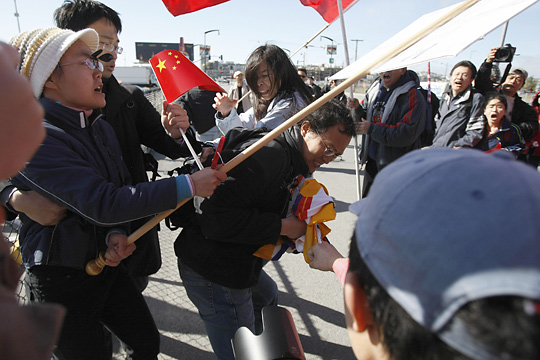
Just got back from a long day chasing the "disappearing torch" across San Francisco. There were over 6,000 protesters that turned out and about as many ethnic Chinese countering. It was a victory for those of us involved in shedding more international attention and light on the human rights abuses China has committed, without any real consequence, over the past half-century in Tibet. The BBC Radio called it "The Parade of the Disappearing Torch," while the Toronto Globe and Mail called it a "hasty tour."

In the end it was just that. Going to elaborate lengths to make sure as few people actually saw the torch as possible, San Francisco city officials were, in the end, unable to avoid protesters who were in constant communication via text messaging and able to re-deploy along the last-minute altered route.

I myself was lucky enough to be part of a team of people trying to hang banners along the parade route that would visually support the protests going on at street level. Thanks to a crackerjack Communications team we were all informed of changes to the route and quickly figured out how to get back along the buses carrying the torch.

Here are some quick observations from the day:
- There were as many if not more China supporters as Tibet supporters.
- There were an amazing amount of extra-large Chinese flags flown in just for the event. Regardless, the impact of hundreds of large, bright red flags aligning the parade route had a visual impact that is hard to beat. Classic Communist tactic?
- Once the parade route changed, the "non-partisan" crowd thinned dramatically. Thousands were left stranded along the original route by the Embarcadero.
- Police presence was overwhelming especially close to the torch.
- Media was in the dark -- most had no idea where the torch was or were jockeying to catchup. This is why I think you will not see a lot of pictures or video of most of the actions taken by protesters.
- One runner dropped out two days before the parade, and another pulled a Tibetan flag out of her shirt-sleeve as she handed off the torch but was quickly grabbed by police and Chinese officials before being shoved back into the crowd.

Overall, I was amazed at some media had chosen to paint a rosy picture of the day's events. I was even more amazed at how incredibly, flat out wrong other new stories were. It made me wonder if they were being written by someone actually in San Francisco or by someone back in London or New York.

I was part of a group of about 10 people that tried to stop the torch caravan (which included about 50 riot police, 30-40 police on dirt bikes, two buses, 4-6 motorcycles from the SFPD and a whole host of police cars and unmarked vehicles). We were able to slow it down and deploy ourselves and a banner across the width of a four-lane street but were "absorbed" by a flock of police in a matter of seconds. No arrests were made but trust me when I say we were all kicked to the curb, that that's exactly what the SFPD did. I'm guessing that most of these officers were not trained in negotiation tactics (unless by negotiate you mean bruise and pummel). I'd like to know if I can trade in my brand new grated elbows and torn clothes for the ridiculous parking tickets SFPD LOVES to hand out.

Here is a decent video of what was happening on the ground. More on this later...

Monday, April 07, 2008

Bomb It

"This is the biggest art movement in the history of human kind." I bet you don't know what the medium is.

"Bomb It,"
the new documentary about the rise of the graffiti movement in urban regions throughout the world, shows the explosion of underground "tagging" as both an art, and a form of communication (some would argue that any art is a form of communication, which I would agree with). Be it Barcelona, New York, Jo'burg, Berlin or Chicago, this movement has gone way beyond the cultural name-tags ascribed to it years ago yet is still true to its roots. Nor is it dominated by criminals, drug addicts, or delinquents. The artists are legitimate and their work is magnificent.

While I do question the painting of personal property (like cars and homes) I agree that the public space available for this type of art is actually extremely limited since so much of public space is actually reserved for advertising (sides of public buses, highways, etc). So, like any American people are taking it back. I don't blame them.

On a whim, I actually caught one of the original graffiti culture/ hip-hop flicks from 1983 called "Wild Style" last weekend. It should be fun to do a comparison of the two after seeing Bomb It.

I'll be checking it out this weekend and maybe you will too.

Friday, April 04, 2008

40th Anniversary of MLK Memphis Speech

The last two minutes of Dr. Martin Luther King's are shockingly prescient. An incredibly powerful speech that is always good to go back to periodically. He was assassinated hours after this address.


Monday, March 31, 2008

Securing the torch

The world's attention has been on the tiny mountain kingdom of Tibet over the past two weeks after protests in 6 different Chinese cities erupted over the course of several days beginning on March 14. However, China, in the midst of working to downplay and even blame the protests and violence on Tibetan "revolutionaries"", is pushing through to start the Olympic Games of 2008 in Beijing by launching the traditional torch ceremony this morning. Granted security was tight, this didn't stop numerous other protests from re-igniting throughout the region.

China continues to dig itself deeper into a hole lacking any integrity by holding fast to the blame game -- that the Dalai Lama and his supporters instigated the riots and violence that followed the March 14th protests. China should know now that the world won't believe their bureaucratic spin on a situation that has clearly gotten out of hand. Also, does Hu Jintao and the Chinese Communist Party leadership really want to get into a "he said, we said" battle with perhaps the most revered living religious leader on the planet? Its not a battle they can win but I don't see them backing down, even against strong international pressure. Yet eyes widened at yesterday's news that German Chancellor Angela Merkel would not be attending the opening ceremonies of the games because of the Chinese crackdown in Tibet has started a flurry of rumors that other EU leaders (Sarkozy) would follow suit. Merkel became the third world leader (joining Poland's PM Donald Tusk and the Czech Republic's President Vaclav Klaus) to abandon the highly regarded opening ceremonies.

The U.S.'s role in this has been minimal. On the ground activists from Students for Free Tibet (who have been doing a splendid job of communicating information, organizing people on multiple continents and adopting a successful argument for this opportunity and moment) continue to drive energy for the boycott of the Beijing Games. But this is almost an impossible outcome, barring some foreign policy disaster on the part of Jintao's government.

First - the Olympic Games were structured around the idea of putting aside politics, war, and differences to come together to compete. As long as the American Olympic Committee decides not to let politics (read "human rights abuses") interfere with the games, America will be in Beijing for the 2008 Winter Games.

Second - the current American leadership lacks the understanding of what a boycott on behalf of Tibet could accomplish. The last Olympic Games that the U.S. sat out of was in Moscow 1980. Jimmy Carter had specific reasons for the boycott, least of which was the recent Soviet invasion of Afghanistan. Carter understood the impact of such a boycott on the Soviet image and worked overtime to get more than 60 nations to join the U.S. in abstaining from the games. That sent a message to the Soviet leadership. But today's American top-dogs aren't very good away from the doghouse and would never be able to see the benefit in moving China into discussions with Tibet.

Third - corporate America has too much invested in the Olympic Games. This is one of the few moments every decade when these companies have the entire world's eyes and ears -- there isn't anyway they're going to forego that opportunity. And if the U.S. pulls all of its athletes out many of those corporate contracts would fall apart. Combine NBC Sports, AT&T, General Electric, Coca-Cola and others.

Lastly - China currently holds over $1.5 trillion in U.S. debt. Even if Bush could build an argument for why China should begin open talks with Tibet, he would have very little political power with that much debt in one nation's hands. All they would have to threaten to do is flood the market, stop buying our debt and dump our dollars sending our economy into an absolute tailspin. We have very little leverage with the Chinese at this point.

If a protest of these companies were to occur, a U.S. pullout might be more conceivable. But right now, China is just hoping that Olympic Torch gets back to Beijing as quickly as possible, without any major incidents. I, for one, wouldn't mind seeing it be snuffed out in a country where human rights is still an idea, not a practice.