We decided to stop waiting around for a commerical attacking the issue of oil addiction in this country and made one ourselves. Petrolius, the purple pill that allows us to keep driving around in old technology that burns gas, has kept us from the next great advancement in transportation tech.
Obviously, this is heavy on the tongue in cheek but its also a commentary on where our country is headed and how "in the clouds" we've been when it comes to quitting our addiction to oil.
Enjoy!
Wednesday, September 06, 2006

Tuesday, August 15, 2006
Around the Horn
A Japanese oil tanker collided with a cargo ship and spilled 1.4 million gallons of crude into the Indian Ocean -- the Phillippines call it the region's worst spill.
California could become the first state to create a large network of "no-fishing" zones in an effort to help species of fish, crab and shellfish recover from over-fishing (if you like Dungeness crab wait til you see them after a couple years of R&R).
But, its more than overfishing that is killing our seafood specimens: a dead-zone along the Pacific coast is so oxygen depleted that massive crab and fish die-offs are taking a toll on the fishing industry on the west coast.
A U.S. district judge slaps every Katrina victim in the face...
California could become the first state to create a large network of "no-fishing" zones in an effort to help species of fish, crab and shellfish recover from over-fishing (if you like Dungeness crab wait til you see them after a couple years of R&R).
But, its more than overfishing that is killing our seafood specimens: a dead-zone along the Pacific coast is so oxygen depleted that massive crab and fish die-offs are taking a toll on the fishing industry on the west coast.
A U.S. district judge slaps every Katrina victim in the face...
Sunday, August 13, 2006
Voting for Freedom From Oil
RAN is having a vote to choose a new ad campaign around their Freedom From Oil work. You can cast your vote at Jumpstart Ford's website for the best photograph that depicts how we can break our addiction to oil and then checkout the results. The winning photo will be featured in RAN's ad campaign this fall.
Wednesday, June 21, 2006
Vacation
I've made the jump and am on vacation for the next week. This will, hopefully, provide a chance for me to re-dedicate myself to writing. So...with that in mind here are few great quotations on vacations.
Oh Robbie boy, you've got give it a better go than that!
Guilty as charged. But how often do your vacations not go directly according to plan (which results in no real loss except more time to kick back) versus how often your work plans fall apart (which results in much loss and stress for everyone involved)? Its more fun to plan things you want to do that are different from your everyday habit. Imagine how fun work would be if we took more vacations? I think the Europeans have it down...
I do not really like vacations. I much prefer an occasional day off
when I do not feel like working. When I am confronted with a whole week in
which I have nothing to do but enjoy myself I do not know where to begin.
To me, enjoyment comes fleetingly and unheralded; I cannot determinedly enjoy
myself for a whole week at a time.
~Robertson Davies
Oh Robbie boy, you've got give it a better go than that!
If we would only give, just once, the same amount of reflection to what we
want to get out of life that we give to the question of what to do with a two
weeks' vacation, we would be startled at our false standards and the aimless
procession of our busy days. ~Dorothy Canfield Fisher
Guilty as charged. But how often do your vacations not go directly according to plan (which results in no real loss except more time to kick back) versus how often your work plans fall apart (which results in much loss and stress for everyone involved)? Its more fun to plan things you want to do that are different from your everyday habit. Imagine how fun work would be if we took more vacations? I think the Europeans have it down...
Tuesday, March 14, 2006
Closing Down SXSW
Sitting here in the Halcyon coffee shop in downtown Austin, TX with a bunch of other haggard (but happy) Southies, the initial reaction to this year's interactive conference is one of optimism and reassurance. Optimism in the sense that normal everyday folk are doing some amazing work in empowering everyday people on the internet. Reassurance in the sense that there IS so much creative lift within this community of developers, designers, coders, programmers, e-theroists, organizers and entepreneurs.
Bruce Sterling, one of the foremost social comentator bloggers and sci-fi writers of our time, closed out the 4 day event with a wonderful speech around the power of the human experience. I left his talk with a real sense of "We Can..." (those of you who are Deanaics out there will have horrible flashbacks to a certain song that bore its ugly head when "on hold"). I realized that we were the transition generation (as my buddy Stan notes, "we're all a part of transition generation!") from an offline world to an online world. Sterling defines past generations as "legacy people" who read the newspapers, believe in TV and radio and go into work where they keep their 'work things.' I realized just how free we are as a generation. I can work from home continually, get all my news from NYtimes.com or Salon.com, can talk to my friends via email, text message or instant message, edit webpages and do my writing and journaling on various blogs. Heck, I can buy all my necessary items to live online and have them delivered to my door. But this is all old information. What Sterling is talking about is how this generation will handle the future. We are a group of people who grew up on the internet. We straddle legacy. Early memories still revolve around big-wheels, barbies and television with only 30 channels. Now, our days are filled with keyboards, texting and walking, gaming and wireless communication. We are the transition generation -- transitioning to an "internet of things" where we can make "reality simple again."
But is this freedom really a facade? Obviously it is. As soon as you lack the power to drive a wireless access point or a computer you lose your "freedom." Sterling is big on the "cradle to cradle" idea and very much embraces the idea of returning to our roots as a human species. Whether that means technology will play a role is still a major question. Where will it lead us?
Sterling is living in Belgrade, Serbia with his wife (also a writer) where one saying rules the day: Make no decision out of fear.
Bruce Sterling, one of the foremost social comentator bloggers and sci-fi writers of our time, closed out the 4 day event with a wonderful speech around the power of the human experience. I left his talk with a real sense of "We Can..." (those of you who are Deanaics out there will have horrible flashbacks to a certain song that bore its ugly head when "on hold"). I realized that we were the transition generation (as my buddy Stan notes, "we're all a part of transition generation!") from an offline world to an online world. Sterling defines past generations as "legacy people" who read the newspapers, believe in TV and radio and go into work where they keep their 'work things.' I realized just how free we are as a generation. I can work from home continually, get all my news from NYtimes.com or Salon.com, can talk to my friends via email, text message or instant message, edit webpages and do my writing and journaling on various blogs. Heck, I can buy all my necessary items to live online and have them delivered to my door. But this is all old information. What Sterling is talking about is how this generation will handle the future. We are a group of people who grew up on the internet. We straddle legacy. Early memories still revolve around big-wheels, barbies and television with only 30 channels. Now, our days are filled with keyboards, texting and walking, gaming and wireless communication. We are the transition generation -- transitioning to an "internet of things" where we can make "reality simple again."
But is this freedom really a facade? Obviously it is. As soon as you lack the power to drive a wireless access point or a computer you lose your "freedom." Sterling is big on the "cradle to cradle" idea and very much embraces the idea of returning to our roots as a human species. Whether that means technology will play a role is still a major question. Where will it lead us?
Sterling is living in Belgrade, Serbia with his wife (also a writer) where one saying rules the day: Make no decision out of fear.
Sunday, March 12, 2006
South By and On

Two days into the conference and I can honestly say that many of the greatest minds here will play a role in changing the digital landscape of our future. And, since that digital landscape is becoming more and more linked to our physical landscape, these folks will indirectly play a role in how we all live our lives (and children's lives) down the road.
SXSW Interactive is the geek extension to the long-running SXSW Music and Movies Conference in Austin, TX. Basically, its an excuse for all the part-time bloggers, filmakers, developers, designers, programmers and (recently) industry reps from IBM, Dell and Apple (Apple sent the most) to come together and meet, talk to, share stories and shake hands with their web heroes. My buddy Stan Jones is a talented designer who got to meet Jeffrey Zeldman, a designer who changed the way everyone at this conference thinks about web design through his book Designing With Web Standards. I was able to hear Jason Kottke and meet other bloggers of community fame.
But what really stands out at an event like this is how much already in motion everyone is. I don't think the number of individuals here who are "blown away" by the content being discussed and introduced any more than other web conferences I've been to. In fact, I think most folks here know already much of the content being thrown around and talked about. So, does this mean that all of us techies are on the same page when it comes to web development? Maybe this community of interactive folks is more tight knit than we had previously estimated, and we're really only separated by 1 or 2 degrees?
Regardless, these conferences are necessary and an integral part of the community. Why are they necessary when we can be connected with audio, video, intstant messenger, cell phone, and text message? Because nothing can replace the human experience of meeting someone, shaking their hand and sitting down over a morning coffee to discuss a project that at the same time baffles and astounds you. And we're bound to have that here. The creativity is being scraped off the walls like butter and slathered over all who are willing to soak it in.
Gotta love Austin.
Friday, February 17, 2006
Philippines Mudslides and Illegal Logging
The recent mudslides in the Philippines has wreaked havoc on a the residents and natural regions around the south-east Asian archipelago, especially on the island of Leyte. It being monsoon season heavy rains have fallen for over three days in the region. Thousands are reported to be buried in one of the worst mudslides in the country's history.
The Philippines have a rough history with natural disasters. In 2003 mudslides claimed over 80 people and hundreds went missing. In 2001, a typhoon killed 36 people after it caused massive mudslides and flooding. The blame for the latest mudslide is falling to illegal loggers who are raping most of the rural regions with clear cutting of hardwood forests. Its not the first time illegal logging has been put on the hot seat either. So, one hopes that the country, but more importantly the world, begins to realize that buying such products from the asian wood market is directly connected to these disasters. The folks sitting in their tropical hardwood chairs and couches who give large checks to the American Red Cross after disasters like this could probably do better to educate themselves on the devastation their furniture causes. The bottom line is its a circular process...we're all connected.
Checkout a devastating report on the causes of illegal logging, how its connected to American consumers and the effects of such deforestation on the natural environment.
Already, the country is dealing with soil erosion and deforestation (most of it illegal) not to mention high pollution levels among the ancient mangrove swamps where the majority of their fish stock are bred.
The Philippines have a rough history with natural disasters. In 2003 mudslides claimed over 80 people and hundreds went missing. In 2001, a typhoon killed 36 people after it caused massive mudslides and flooding. The blame for the latest mudslide is falling to illegal loggers who are raping most of the rural regions with clear cutting of hardwood forests. Its not the first time illegal logging has been put on the hot seat either. So, one hopes that the country, but more importantly the world, begins to realize that buying such products from the asian wood market is directly connected to these disasters. The folks sitting in their tropical hardwood chairs and couches who give large checks to the American Red Cross after disasters like this could probably do better to educate themselves on the devastation their furniture causes. The bottom line is its a circular process...we're all connected.
Checkout a devastating report on the causes of illegal logging, how its connected to American consumers and the effects of such deforestation on the natural environment.
Already, the country is dealing with soil erosion and deforestation (most of it illegal) not to mention high pollution levels among the ancient mangrove swamps where the majority of their fish stock are bred.
Thursday, February 16, 2006
Ecologist on RAN
The organization I work for, Rainforest Action Network, is being featured in this month's Ecologist. If anything I'm interested in what folks are thinking about some of the work we do as the article does a great job of grasping what our work has accomplished, some of its shortfalls, what we hope to accomplish and how we operate "under the radar" of the media and major networks. You can't get the article online (!) but you can grab it at your Barnes and Noble (or local bookshop newsstand of your choice...I think.)
Granted its a friendly news source (in case you couldn't tell the Ecologist is a bit of a softball for us) and many of our victories are garnering more attention especially in the financial sector with the likes of JP Morgan Chase, Bank of America, Citigroup, Goldman Sachs and now Wells Fargo. But its nice to finally get a little press outside of American Banker and Investors Daily. Not exactly mainstream, y'know?
Checkout the global finance campaign's website DirtyMoney for more info:
http://www.dirtymoney.org
Otherwise, see the new RAN website that will be released in the coming weeks.
http://www.ran.org
Granted its a friendly news source (in case you couldn't tell the Ecologist is a bit of a softball for us) and many of our victories are garnering more attention especially in the financial sector with the likes of JP Morgan Chase, Bank of America, Citigroup, Goldman Sachs and now Wells Fargo. But its nice to finally get a little press outside of American Banker and Investors Daily. Not exactly mainstream, y'know?
Checkout the global finance campaign's website DirtyMoney for more info:
http://www.dirtymoney.org
Otherwise, see the new RAN website that will be released in the coming weeks.
http://www.ran.org
Monday, January 30, 2006
NASA to Scientists: Shutup!
For those of you who dont know him, James Hansen discovered of global warming. Well, not quite, but he has been the alarm bell since 1988 warning governments and business leaders that the heat trapping gases CO2 and NOx are causing climate fluctuations that wouldn't otherwise be happening. Bill McKibben features a full run-through of Hansen's expereince on the Senate floor back in 1989 in his book End of Nature. If you haven't read it...pick it up.
Hansen now says that NASA and administration officials have been asked to review all his interview requests, coming lectures, papers and postings to the Goddard Insitute website often before they are released. I guess the odd piece here is why are public affairs officials reviewing scientific data and results being posted publicly on a website by one of the world's renowned climate scientists?
Well apparently they're doing it alot.
Except when the policy statements are tied to imperical data from one of the most accomplished climate scientists in the world. Don't we PAY him for his opinion? Isn't this like paying a basketball fan to go out and play for Kobe Bryant? Let the man talk! He's smart! Its why we pay him tax dollars.
And here's where it gets interesting:
Hansen now says that NASA and administration officials have been asked to review all his interview requests, coming lectures, papers and postings to the Goddard Insitute website often before they are released. I guess the odd piece here is why are public affairs officials reviewing scientific data and results being posted publicly on a website by one of the world's renowned climate scientists?
Well apparently they're doing it alot.
Dean Acosta, deputy assistant administrator for public affairs at the space agency said there was no effort to silence Dr. Hansen. "That's not the way we operate here at NASA," Mr. Acosta said. "We promote openness and we speak with the facts."
He said the restrictions on Dr. Hansen applied to all National Aeronautics and Space Administration personnel. He added that government scientists were free to discuss scientific findings, but that policy statements should be left to policy makers and appointed spokesmen.
Except when the policy statements are tied to imperical data from one of the most accomplished climate scientists in the world. Don't we PAY him for his opinion? Isn't this like paying a basketball fan to go out and play for Kobe Bryant? Let the man talk! He's smart! Its why we pay him tax dollars.
And here's where it gets interesting:
The fresh efforts to quiet him, Dr. Hansen said, began in a series of calls after a lecture he gave on Dec. 6 at the annual meeting of the American Geophysical Union in San Francisco. In the talk, he said that significant emission cuts could be achieved with existing technologies, particularly in the case of motor vehicles, and that without leadership by the United States, climate change would eventually leave the earth "a different planet."
The administration's policy is to use voluntary measures to slow, but not reverse, the growth of emissions.
After that speech and the release of data by Dr. Hansen on Dec. 15 showing that 2005 was probably the warmest year in at least a century, officials at the headquarters of the space agency repeatedly phoned public affairs officers, who relayed the warning to Dr. Hansen that there would be "dire consequences" if such statements continued, those officers and Dr. Hansen said in interviews.
Almost sounds as if it was cut from a movie script. The scary piece of this is that now no scientist can get on a call with press unless several public affairs officials from NASA are on the call as well. Are they translating something? What the heck is the point other than to twist results in the name of political gain?
PS: Arthur over at Its Getting Hot in Here has a great post on this as well.
Sunday, January 15, 2006
The Power of Algae
Small steps toward curbing global warming emissions is coming out of the hub of tech/science advancement using one of nature's most simple organisms: algae. Isaac Berzin of MIT has created bioreactors of algae that strip the CO2 and NOx pollutants from emitting power plant smokestacks removing up to 40% of the CO2 and 90% of the NOx.
Working much like a screen, the algae bioreactors use photosynthesis to absorb the CO2 and other pollutants and emit oxygen instead. The algae is then harvested daily and from it a combustible vegetable oil is squeezed out. This fuel can be used as biodiesel and is some of the cleanest fuel that can be burned for cars running on "veggie-oil." The dried solid is then clumped together and can be burned as a cleaner coal. Ethanol is also a by-product of this process.
The most impressive side of this plan, however, is Berzin's business strategy that lays out the way in which utilities and coporations can make money off of the deal. By setting up algae farms, the biodiesel and ethanol can be sold as additional energy products.
Berzin's company in Cambridge, GreenFuel Techonologies is dedicated to educating all about the massive economic and ecologic bonuses coming out of clean air biofuels.
This is a good step in removing CO2 and NOx gases from the atmosphere but I also hope that eventually we'll move towards a more sustainable fuel source using solar and wind. The bottom line is this method is used on smokestacks that continue to belch out millions of pounds of CO2 and NOx every year and isn't really advancing the techological capability of clean energy. However, I'm all for supporting ways in which to clean up our environment, and this is one of the more interesting ways to help our air quality. I also don't want to ignore the fact that had we developed cleaner energy tactics a century ago we wouldn't be looking for ways to limit our emissions today. Still, who woulda thunk algae can absorb such dirty pollutants?
Working much like a screen, the algae bioreactors use photosynthesis to absorb the CO2 and other pollutants and emit oxygen instead. The algae is then harvested daily and from it a combustible vegetable oil is squeezed out. This fuel can be used as biodiesel and is some of the cleanest fuel that can be burned for cars running on "veggie-oil." The dried solid is then clumped together and can be burned as a cleaner coal. Ethanol is also a by-product of this process.
The most impressive side of this plan, however, is Berzin's business strategy that lays out the way in which utilities and coporations can make money off of the deal. By setting up algae farms, the biodiesel and ethanol can be sold as additional energy products.
For his part, Berzin calculates that just one 1,000 megawatt power plant using his system could produce more than 40 million gallons of biodiesel and 50 million gallons of ethanol a year. That would require a 2,000-acre "farm" of algae-filled tubes near the power plant. There are nearly 1,000 power plants nationwide with enough space nearby for a few hundred to a few thousand acres to grow algae and make a good profit, he says.Now, the utilities aren't just gouging people for energy usage but are instead making it back in the form of fairly green energy. This explosion of biodiesel as a clean fuel could begin to affect car companies as more and more become open to producing diesel versions of their most popular vehicle for customers who want to drive on veggie oil.
Berzin's company in Cambridge, GreenFuel Techonologies is dedicated to educating all about the massive economic and ecologic bonuses coming out of clean air biofuels.
This is a good step in removing CO2 and NOx gases from the atmosphere but I also hope that eventually we'll move towards a more sustainable fuel source using solar and wind. The bottom line is this method is used on smokestacks that continue to belch out millions of pounds of CO2 and NOx every year and isn't really advancing the techological capability of clean energy. However, I'm all for supporting ways in which to clean up our environment, and this is one of the more interesting ways to help our air quality. I also don't want to ignore the fact that had we developed cleaner energy tactics a century ago we wouldn't be looking for ways to limit our emissions today. Still, who woulda thunk algae can absorb such dirty pollutants?
Sunday, December 18, 2005
Wedges and Wedgies
Billy Parish of Energy Action posted a great post on a blog I helped get cranking called Its Getting Hot in Here (was the blog for the activist base during the Montreal climate talks last week but is now becoming the youth blog for students activists and the like).
Princeton released the study, that as Billy points out, was also sponsored by Ford Motor Company (you'll see a gratuitous photo of an Escape in the flash presentation) and BP. I, like Billy, don't agree with all the solutions they map out as many have side effects that would only add to the carbon problem in the atmosphere (and why the hell are people thinking nuclear is a good way to go?) Also, I, like Billy, agree that simply hoping to put a ceiling on emissions is aiming too low. As the study points out we do have the technology to make great leaps past global warming (as opposed to simply making the least possible effort) and create a new society not based on coal and oil. Too bad the study leaves some of those out.
Princeton released the study, that as Billy points out, was also sponsored by Ford Motor Company (you'll see a gratuitous photo of an Escape in the flash presentation) and BP. I, like Billy, don't agree with all the solutions they map out as many have side effects that would only add to the carbon problem in the atmosphere (and why the hell are people thinking nuclear is a good way to go?) Also, I, like Billy, agree that simply hoping to put a ceiling on emissions is aiming too low. As the study points out we do have the technology to make great leaps past global warming (as opposed to simply making the least possible effort) and create a new society not based on coal and oil. Too bad the study leaves some of those out.
Thursday, December 08, 2005
Mo' Money Less Happy
The CS Monitor continues to cover more interesting topics than the NYT and their December 5th article on what constitute's happiness in this money-driven world struck a chord with my innner spendthrift. For instance, according to research done by a Warwick University economist and Dartmouth economist David Blanchflower, marriage equates to about $100,000 in happiness value...not that I think we should be putting a price on marriage (prenup would take on a whole new significance). However, it is interesting that we have to translate non-monetary value in our lives (family, marriage, health, friends) into monetary figures in order to fully understand the value of them.
Here are some additional "happpiness related" findings of Blanchflower's research:
• Nations (at least those in the West) do not grow happier as they grow richer.
• Women report higher levels of well-being than do men.
• Two of the biggest negatives in life are unemployment and divorce.
• Better-educated people report higher levels of happiness, even after taking income into account.
Here's another kicker: research shows overwhelmingly that married, monogamous couples are the happier than others.
Maybe this will change the way we look at our GDP in the future. Happiness isn't equated into GDP and judging by the first bullet point above it's time we start rethinking how we define what success is in life. Wealth is nice, but it's only a basic piece of a larger pie that includes such things as love, spirituality, health, longevity and a true understanding of our world. How can we start creating a culture of happiness?
A consumption tax that raises the income tax would help to deflate the purchase of items like yachts, vacation homes, 8,000 square foot homes and other un-needed extravagances. That money could then be used to increase public works, education, government programs to make more people happy. How about a 4 day work week so we can all spend more time with our families and more importantly, with ourselves. The best part of this idea is that this type of tax would actually stimulate savings in American families and promote investment.
Whats the definition of happiness anyways? Gosh, can you buy happiness?
Here are some additional "happpiness related" findings of Blanchflower's research:
• Nations (at least those in the West) do not grow happier as they grow richer.
• Women report higher levels of well-being than do men.
• Two of the biggest negatives in life are unemployment and divorce.
• Better-educated people report higher levels of happiness, even after taking income into account.
Here's another kicker: research shows overwhelmingly that married, monogamous couples are the happier than others.
That's because it finds, for instance, that those in a monogamous, faithful marriage are the happiest. In the dry language of the paper, "The happiness- maximizing number of sexual partners in the previous year is one."
Those who cheat on their spouses are less happy. Those who have ever paid for sex are much less happy than others. So are those who divorce.
Maybe this will change the way we look at our GDP in the future. Happiness isn't equated into GDP and judging by the first bullet point above it's time we start rethinking how we define what success is in life. Wealth is nice, but it's only a basic piece of a larger pie that includes such things as love, spirituality, health, longevity and a true understanding of our world. How can we start creating a culture of happiness?
A consumption tax that raises the income tax would help to deflate the purchase of items like yachts, vacation homes, 8,000 square foot homes and other un-needed extravagances. That money could then be used to increase public works, education, government programs to make more people happy. How about a 4 day work week so we can all spend more time with our families and more importantly, with ourselves. The best part of this idea is that this type of tax would actually stimulate savings in American families and promote investment.
Whats the definition of happiness anyways? Gosh, can you buy happiness?
Sunday, December 04, 2005
How Literate Are You?
A new report by the NEETF (National Environmental Education and Training Foundation) has some startling news to those of us claiming to be eco-literate: what we don't know is going to kick our ass (ass = planet).
Usually, once someone understands something they are able to better make informed decisions about it. This new report, Environmental Literacy in America, explains over a decade of studies and research backgrounding Americans' environmental literacy. Joe Makower over at WorldChanging has a fantastic analysis. What's disconcerting is that it's final conclusion is that we don't know the half of how degraded our home turf really is.
One clip that caught my eye (besides the jaw-dropping results) was the idea of "nature-deficit disorder" (oh please let's not have a new pill for this one--I'm hoping scientists figure out the cure for this disorder is a few years in the outback or Canadian wilderness). NDD, as I like to call it, basically explains the pattern shifts in how young people interact with their natural environment:
Usually, once someone understands something they are able to better make informed decisions about it. This new report, Environmental Literacy in America, explains over a decade of studies and research backgrounding Americans' environmental literacy. Joe Makower over at WorldChanging has a fantastic analysis. What's disconcerting is that it's final conclusion is that we don't know the half of how degraded our home turf really is.
One clip that caught my eye (besides the jaw-dropping results) was the idea of "nature-deficit disorder" (oh please let's not have a new pill for this one--I'm hoping scientists figure out the cure for this disorder is a few years in the outback or Canadian wilderness). NDD, as I like to call it, basically explains the pattern shifts in how young people interact with their natural environment:
As kids become more "wired" than ever before, they are drawn away from healthful, often soul-soothing, outdoor play. The age-old pattern of children spending hours roaming about and playing outside is becoming close to extinct due to a combination of electronics, cyberspace, and parental efforts to keep their children indoors and, in their minds, safer.
This also explains why we are the only country in the world to have 12 year-olds that are routinely mistaken for dwarfish versions of Steelers linemen at the local TCBY. It fits with my experiences as a summer camp counselor. When asked where our food comes from, some of our campers (including the 16 year olds) simply said, "the grocery store." Ok, but how does the grocery store get it? "I don't know...they order it from other grocery stores, I guess," said one 11 year old. Yikes. Once more the dichotomy between the natural world and our children's everyday experience seems shockingly vast. All I can say is thank god I grew up in Vermont where I could see dairy farms, family farms and a piece of the process in how our food arrives at grocery stores. And thanks to summer camps where I was forced to spend 4 days a month out in the Appalachian wilderness (ok...not really wilderness but pretty close) with nothing but oatmeal and a tent (ok...we had more than that - but not much).
Wednesday, November 30, 2005
Cowboy in a Straitjacket
The thing about binding agreements is that...well, they're binding. In this case, an international protocol was deemed "unfair" by George Bush because it excluded developing nations. That's kind of like complaining that your neighbor's Fiat emits more pollution than your John Deere...yet you have three SUVs in the garage and heat your house by burning coal. Once again Mr. Bush fails to see the bigger picture here. Maybe that explains why he feels like a cowboy in a straitjacket when dealing with global warming?
Today, Harlan Watson , the Chief Climate Negotiator for the U.S. in Montreal (talk about a dubious title), ruled out making pledges to fight global warming beyond 2012 which happens to be precisely when the Kyoto Protocol runs out. You just have to be skeptical of a guy who was recommended by Exxon-Mobil to be the U.S. Chief Climate Negotiator. Here's my favorite part:
Today, Harlan Watson , the Chief Climate Negotiator for the U.S. in Montreal (talk about a dubious title), ruled out making pledges to fight global warming beyond 2012 which happens to be precisely when the Kyoto Protocol runs out. You just have to be skeptical of a guy who was recommended by Exxon-Mobil to be the U.S. Chief Climate Negotiator. Here's my favorite part:
Up to 10,000 delegates are meeting in Montreal, Canada, from November 28-December 9 to discuss new ways to fight a build-up of gases released mainly from burning fossil fuels in factories, power plants and cars."The United States is opposed to any such discussions," Watson told a news conference of Canadian proposals to launch talks under the U.N.'s climate convention about new actions to combat global warming beyond 2012.
I gotta ask: Harlan, if you have no interest in these discussions why are you up in Montreal freezing your cheeks off? I can't figure out if you're wasting our time or your own. While Harlan shuffles his feet the rest of country is taking steps forward. While U.S. CO2 emissions were lower than the EU's between 2000-2003, what they aren't telling you is that the U.S. was almost %14 higher in '03 than in 1990 while the EU was a mere %1.4 higher for the same period.
Monday, November 28, 2005
New York Steps Up
When California decided to set its own air quality standards back in 1970 it had no idea what impact that action would take years down the line. Now, states like Vermont and New York are jumping aboard the clean air bandwagon and snubbing federal EPA standards, establishing their own stricter, safer and more demanding emission regulations. The rules, laid out by California, are expected to be followed by as many as 10 other states including New York in the coming year.
Automakers continue to complain (and sue) that these new regulations will limit the availability of many of our favorite trucks, SUVs and larger sedans as well as force them to curb sales of more powerful engine vehicles in the state. If these 10 states (including California) succeed in passing these new regulations they'll be an amazingly powerful regulatory bloc that automakers will have to contend with. Even more important, these markets will account for over a third of the nation's auto sales.
AAM (which has a virtually identical slogan to Ford Motors) says the California legislation will hurt SUV, truck and large car owners the most:
Automakers continue to complain (and sue) that these new regulations will limit the availability of many of our favorite trucks, SUVs and larger sedans as well as force them to curb sales of more powerful engine vehicles in the state. If these 10 states (including California) succeed in passing these new regulations they'll be an amazingly powerful regulatory bloc that automakers will have to contend with. Even more important, these markets will account for over a third of the nation's auto sales.
AAM (which has a virtually identical slogan to Ford Motors) says the California legislation will hurt SUV, truck and large car owners the most:
"The California legislation would hurt the most the people that rely on large cars, pickups, S.U.V.'s and minivans," Ms. Bergquist said.Environmental groups say the rules can be met with technology already on the shelf.
"They said that seat belts would put them out of business; they said that air bags would put them out of business; they said fuel economy and emissions regulations would all put them out of business," said David Friedman, a senior analyst at the Union of Concerned Scientists.
"It turns out it's their unwillingness to innovate that's putting them out of business right now," he added, referring to the current struggles of General Motors and Ford Motor Company.
It seems like America's best automanufacturers are ignoring innovation not adopting it. If anything, American auto companies are busy working to paint every vehicle they produce as a green one.
The push for states to inact their own emission regs will only continue. California, Vermont and New York are on the list...keep your eyes on the others (RI, ME, NJ, MA, OR, WA, CT, PA).
Montreal Conference on Climate Change
I may be heading up to Montreal this week to analog the festivities going on around the world's most wonkified conference concerning climate change. It also happens to be THE most important meeting of the parties (i.e. those that signed the Kyoto Protocol) ever. Why? Because this is the meeting where everyone sits down to discuss how they're (I use "they" because the U.S. never signed it---but thank god for Russia) going to implement the rules and regulations agreed upon. More importantly, they're going to layout a plan for post-Kyoto which runs out in 2012.
This is fairly significant and over 10,000 dignataries and representatives from over 150 countries will be flying in to take part. Of course, the U.S. will have a delegation that's chief job will be to monitor the actions of our allies (and enemies) to see what type of trade regulations may be impacted as a result various restrictions that come out of the conference.
And while the wonks and dignataries sit inside discussion numbers and objectives, thousands of activists from all over the world will be gathered (actually, they've been there for weeks already) weighing in on the public conversation taking place. Hundreds of side events around the conference will be open to the public and anyone who wants to hear the stories behind global warming and climate change.
Lastly, if you can't go there in person, why not watch from the web? Energy Action and Rainforest Action Network established a hub where everyone and their mother will be working to post updates on whats going on from the ground in Montreal both inside and outside the conference. Should be interesting...do we think Nelly will endorse this?
This is fairly significant and over 10,000 dignataries and representatives from over 150 countries will be flying in to take part. Of course, the U.S. will have a delegation that's chief job will be to monitor the actions of our allies (and enemies) to see what type of trade regulations may be impacted as a result various restrictions that come out of the conference.
And while the wonks and dignataries sit inside discussion numbers and objectives, thousands of activists from all over the world will be gathered (actually, they've been there for weeks already) weighing in on the public conversation taking place. Hundreds of side events around the conference will be open to the public and anyone who wants to hear the stories behind global warming and climate change.
Lastly, if you can't go there in person, why not watch from the web? Energy Action and Rainforest Action Network established a hub where everyone and their mother will be working to post updates on whats going on from the ground in Montreal both inside and outside the conference. Should be interesting...do we think Nelly will endorse this?
Sunday, November 20, 2005
Carbon Footprints and BP Oil
As more and more people begin to see how oil is no longer a viable resource they will begin to seek out companies that offer alternatives. One of the few oil companies that is beginning to shift in an acceptable direction for research and implementation of alternative energy sources is British Petroleum (BP). BP is the largest investor of all the major oil companies in solar, wind and geo-thermal industries. However, they are also heavily behind clean coal like their competitor Chevron and have been ridiculed for recent environmental "dodgings" in Alaska's Prudhoe Bay involving oil spills. Plus, parts of their "Renewables" section of their website doesn't work and investors and users can't really find out anything about where BP stands on solar and renewable energy. Not a good start.
Yet, there was one piece of the website that I thought was interesting: the Carbon Footprint indicator. Its a online tool that assigns values to certain activities/items in your household like taking a bath vs. taking a shower or how many cars you have and their mileage, all to show a user what their carbon footprint is on the earth. It also includes plane travel which is something often forgotten in a world focused on the vehicle.
Most of what these oil companies are marketing in their P.R. efforts is a type of greenwashing. It's telling citizens that they are working hard to focus on renewable energy resources and growing them when in reality they're still focused on age-old practices of ploughing and plundering land and sea-bed for hidden oil reserves (which is why oil and gas careers are booming right now). While showing people their carbon footprint is a fun and educational way of communicating the effects of an oil economy, remaining unchanged in company practices and treatment of the natural environment brings to light a larger issue based on integrity within that corporation. Yes we know progress is slow, but progress is also taking a step forward and not trying to cover up or lead astray your investors, clients and customers.
Yet, there was one piece of the website that I thought was interesting: the Carbon Footprint indicator. Its a online tool that assigns values to certain activities/items in your household like taking a bath vs. taking a shower or how many cars you have and their mileage, all to show a user what their carbon footprint is on the earth. It also includes plane travel which is something often forgotten in a world focused on the vehicle.
Most of what these oil companies are marketing in their P.R. efforts is a type of greenwashing. It's telling citizens that they are working hard to focus on renewable energy resources and growing them when in reality they're still focused on age-old practices of ploughing and plundering land and sea-bed for hidden oil reserves (which is why oil and gas careers are booming right now). While showing people their carbon footprint is a fun and educational way of communicating the effects of an oil economy, remaining unchanged in company practices and treatment of the natural environment brings to light a larger issue based on integrity within that corporation. Yes we know progress is slow, but progress is also taking a step forward and not trying to cover up or lead astray your investors, clients and customers.
Sunday, November 13, 2005
Fox For the Environment?
Looks like Fox News is starting to see the light. Tonight Fox National is running a special on global warming and its surrounding effects. While it seems to be a dramatic step for a media conglomerate dedicated to conservative issues and ideals, it is, it does seem to be scraping just the tip of the iceberg when it comes to issues around climate change. However, FOX's look into the culture behind the "disbelievers" is key. The fact that the title of the piece is the same as one of the most prolific books on the subject doesn't seem to be a coincidence either.
Also on TV tonight of note, a 60 minutes piece on eco-terrorism.
Happy viewing.
Also on TV tonight of note, a 60 minutes piece on eco-terrorism.
Happy viewing.
Friday, November 11, 2005
Role Reversal
The folks over at Amazon are doing some pretty incredible things of late. Artificial intelligence (AI) has long intrigued humanity as a way to subsitute flesh and blood humans with machines capable of making decisions and completing tasks that might otherwise be boring, overwhelming or just plain dangerous. Well, now we have Artificial Artificial Intelligence. Amazon's Mechanical Turk does exactly the opposite by creating AAI in computer software that enables them to make requests of humans. Why and how is this useful? Think about all the tasks that we have to have do in a typical business day that computers can't. Everything from information requests to judging the best photo for a marketing firm's campaign are jobs that people like you and me can do without too much trouble. What Mechanical Turk does is bring the needs of business to the solutions of millions of virtual workers who can work from anywhere there is an internet connection.
Michael Silberman over at EchoDitto makes some great points on why this is big:
But don't get too excited. At the moment you'd be hard pressed to find a gig for more a few bucks. You'd still have to file for unemployment if you took this on full time.
Michael Silberman over at EchoDitto makes some great points on why this is big:
This investment is a Big Deal because it speaks volumes about the company's appreciation for (a) the online multiplier effect, where many small, individual actions add up to a larger whole, and (b) the proven nature of distributed and decentralized processing via the 'net.Basically, Amazon has created a tool that enables you to export your simpler (but more challenging) tasks to an army of willing workers online. Using this new API you can submit requests and tasks to the Amazon Turk website, approve completed tasks, and then incorporate those solutions into your own software. On the other end, humans can select HITs (Human Intelligence Tasks) to complete. You get paid once the person who listed the HIT approves your solution or work. So in a sense this is what happens when open-source idealogy mixes into the online job market.
For businesses and entrepreneurs who want tasks completed, the Amazon Mechanical Turk web service solves the problem of getting work done in a cost-effective manner by people who have the skill to do the work. It does this by ccessing a vast network of human intelligence with the efficiencies and cost- ffectiveness of computers. Oftentimes people do not move forward with certain projects because the cost to establish a network of skilled people to do the work outweighs the value of completing it. By turning the fixed costs into variable costs that scale with their needs, the Amazon Mechanical Turk web service eliminates this barrier and allows projects to be completed that before were not economical...For people who want to earn money in their spare time, the Amazon Mechanical Turk website solves the problem of finding work that they can do wherever and whenever they want.
But don't get too excited. At the moment you'd be hard pressed to find a gig for more a few bucks. You'd still have to file for unemployment if you took this on full time.
Thursday, November 10, 2005
House Rules
Just when you thought drilling in the Arctic National Wildlife Refuge was money in the bank...those moderate republicans do us all a favor. Today, the House of Representatives decided to remove the drilling measure from the now tabled budget bill that cuts over $54 billion from federal benefit programs. Over 12 moderate GoOPers played a key role in helping to keep the bill off the floor after expressing concern over cutting extensive social programs that would hurt the elderly and poor. This means is that when the Senate and House meet next week to reconcile their differences on the proposed budget bills there's going to be a battle. Drilling in ANWR has been a major piece of the Bush Energy Plan and as Scott McClellan says, "We continue to urge passage of that initiative."

It's too bad that Bush and fellow republicans are appealing to America's lowest common denominator on this. Undoubtedly, we as a nation when facing challenges in the past relied on American ingenuity to bail us out. We are a nation that responds well to challenges and the current energy problem is one that drilling in another undeveloped pristine landscape will not solve. Conservation is certainly not the only answer. But forcing automakers (especially American automakers) to create cars and trucks that get 45 mpg while swapping our coal power plants for solar techonology and redesigning our cities and suburbs are all easy first steps that when combined with conservation will save us 10 times as much oil (and money) then ANWR would.
So when does AI (American Ingenuity) have a negative effect on national progress? See our esteemed former EPA Chief Gale Norton for a scary look on why AI is keeping people from believing in an energy crisis.
We're glad to see that some moderate republicans helped keep ANWR out of the House budget bill, but their motives for tabling the bill were much different than NRDC's or Sierra Club's. In the end though, its one more roadblock for the Bush Energy Policy. Bush is keeping America from paving the way to a sustainable energy program, one that would lead the world into the new eco-centric future. Instead, he wants us to keep sucking down the oil by drilling in a land untouched by development for enough black gold to last us all of two years.
Oh, and an interesting tidbit regarding our national leaders and ANWR. Checkout where Senator Ted Stevens (R-Alaska) gets most of his money from.
Friday, November 04, 2005
You Can Run...

I'm glad to see the White House Press Corps has begun to find it's backbone. Helen Thomas can breathe a little easier as journalists have rallied to continue putting pressure on President Bush and the questions swirling around his administration's indictments and the CIA leak case. Karl Rove is in the sights of special counsel Patrick Fitzgerald and as the press fires questions to our fearless leader about his senior advisor, the President seems content with aloof replies like, "This is a serious investigation and I have a job to do, an agenda to stick to." Yes, Mr. President, it is a serious investigation, one that involves national security, which is why we're asking you to comment on it.
As Bush travels to Argentina this week for the Fourth Summit of the Americas he's been given anything but a respite from attacks and questions about his job as leader of the free world. Populist Venezulean President Hugo Chavez rallied 25,000 protestors in the region's largest soccer stadium declaring the free trade accord being proposed by Bush as "dead" and accused the Pentagon of having a secret plan to invade his oil-rich country. Well, the first one is probably true, but the second claim...yeah I wouldn't put it past us. If it did happen it would be under the guise of "saving Venezuela" for their own national security.
Yikes. Diego Maradona, in case folks didn't know, is a rather large popular figure to this region of the world. That'd be like...oh I don't know...Michael Jordan coming out publicly against President Bush. Add to the mix today's 1,200 protestors marching only blocks from where the President met with Argentinian leader Nestor Kirchener and we've got quite a little riot party going on in South America. Somehow I think the President is going to have to really push to sell his new FTAA (Free Trade Area of the Americas) proposal, espeically if all of South America is questioning it. Mr. President, you can run from all the questions left unanswered by and your cronies...but you can't hide from them.Polls show Mr. Bush to be the most unpopular American president ever among Latin Americans, and thousands of demonstrators, led by the soccer idol Diego Maradona, are flocking to the Argentine beach resort of Mar del Plata to protest his presence at a summit meeting of Western Hemisphere leaders. The greeting from his fellow heads of state, who have been complaining of his administration's neglect of and indifference to the region for five years, does not promise to be especially warm, either. "He doesn't have any money to offer, so the president doesn't really have any cards to play," said Riordan Roett, director of the Latin American studies program at the Johns Hopkins School of Advanced International Studies. "Nobody among the crop of fiscally conservative but socially progressive presidents that we now have around the region is going to go to his defense."
Thursday, November 03, 2005
Gettin' Your Sprawl On
Via kottke, a picture of suburban sprawl in San Ramon, CA. I really hope we're not STILL doing urban planning like we did in 1950. Talk about a step backwards....
Vermont Leads Fuel Efficiency Charge
Finally, the northeast is getting its act together around tougher policies for vehicle emissions. Wednesday the State Legislature approved a rule stating that all 2009 car models sold in Vermont will be subject to strict new state emissions rules. What are those rules? Well, details to come later. Apparently the ruling is looking to target CO2 and make a real dent in the overall pollution that cars and trucks put out. Do we think that long-time Vermont progressives Ben and Jerry played a roll in this? Possibly, but regardless they make great ice cream.
Why is this big? Well, just ask any automaker. The possibility of not being allowed to sell their F-150s and Tundras isn't exactly going over well in the boardrooms of Detroit. The Alliance of Automobile Manufacturers ("Driving Innovation" is hardly a fair motto here) sued the state of California a few years ago charging that the "new rules" are unfair to consumers as it will increase the cost of the car, on average, about $3,000. California has been leading the charge and blazing a trail for other states to sign up. Vermont is one of the first to follow in the steps of the Golden State and New York, Rhode Island, Connecticut, Maine and the rest of the liberal nor'easters are close behind (oh wait...except for New Hampshire--you gotta question the intelligence of a state who places liquor stores the size of Wal-Mart on all their major highways to avoid paying high taxes...talk about a "sin tax"). Whats interesting is that the two different sets of rules allowed by the federal clean air act for governing emissions on cars are the California standard and the less-strict, industry-loving federal standard. So goes California, so goes the nation? Maybe...
As a Vermonter I'm slightly proud of my state for leading the country to follow in California's wake, especially with a moderate Republican Governor at the helm. So now, to go along with no billboards on highways, we're working on getting the CO2 out as well. Well done Green Mountain State.
Why is this big? Well, just ask any automaker. The possibility of not being allowed to sell their F-150s and Tundras isn't exactly going over well in the boardrooms of Detroit. The Alliance of Automobile Manufacturers ("Driving Innovation" is hardly a fair motto here) sued the state of California a few years ago charging that the "new rules" are unfair to consumers as it will increase the cost of the car, on average, about $3,000. California has been leading the charge and blazing a trail for other states to sign up. Vermont is one of the first to follow in the steps of the Golden State and New York, Rhode Island, Connecticut, Maine and the rest of the liberal nor'easters are close behind (oh wait...except for New Hampshire--you gotta question the intelligence of a state who places liquor stores the size of Wal-Mart on all their major highways to avoid paying high taxes...talk about a "sin tax"). Whats interesting is that the two different sets of rules allowed by the federal clean air act for governing emissions on cars are the California standard and the less-strict, industry-loving federal standard. So goes California, so goes the nation? Maybe...
As a Vermonter I'm slightly proud of my state for leading the country to follow in California's wake, especially with a moderate Republican Governor at the helm. So now, to go along with no billboards on highways, we're working on getting the CO2 out as well. Well done Green Mountain State.
Wednesday, October 12, 2005
Fuzzy Math 101
Tax breaks are more than just money back in the pocket of a possible "do-gooder" or White House "Friend of the Family." They're about the message. What message is the federal government sending when it gives more credit and higher standard deductions to heavier SUV models than to hybrid passenger cars? A pretty clear one: you can have your cake and eat it too.
The recently enacted Energy Policy Act does exactly this with the help of some ancient mathematical tomfoolery (Bush perfers to call it "magic") that gives more money to those who purchase certain SUV hybrids than to those who purchase passenger vehicles like the Prius and Honda Insight. Albeit, I get the general idea here: save more gallons of gas from being burned and we save less from hitting the atmosphere. From Wired...
So, where is the green incentive? We're rewarding people more for buying a less efficient vehicle. If I come home with my . I understand the overall economic reasoning (kind of..even that seems like a stretch) but take a step back and look at why the general tax incentive was created and suddenly this seems like a real failure of being too involved in details. Ballentine's quote is the key to this question: "If the goal is saving oil, then it's not nonsensical."
We want to reward people who buy the most fuel efficient vehicles, not those who simply have the most fuel left in their tank at the end of the day. Afterall, if my tank is bigger than yours (which is the case with SUV gas tanks compared to passenger hybrids) I'll probably save more gas over the life of the vehicle than you ever could with your Prius.
Now, throw into the mix the fact that the tax incentive is manufacturer-specific (yikes...the federal gov't penalizing people for not purchasing from "recommended" brands?) and you've got yourself a thoroughly confusing rebate program, one which I don't have one to sit down to figure out and neither do most Americans.
So, not only will the government encourage people to buy less efficient vehicles with a tax incentive program that was designed to reward those who purchase the most efficient vehicles, but it's allowing itself to pick the businesses and corporations for the very people it governs. Can't say I agree with how this falls inline with the classic conservative mantra, "government out of the private sector."
The recently enacted Energy Policy Act does exactly this with the help of some ancient mathematical tomfoolery (Bush perfers to call it "magic") that gives more money to those who purchase certain SUV hybrids than to those who purchase passenger vehicles like the Prius and Honda Insight. Albeit, I get the general idea here: save more gallons of gas from being burned and we save less from hitting the atmosphere. From Wired...
The odd math is an artifact of a two-tiered tax credit that's based in part on how fuel efficient the car is compared to the average consumption of vehicles of similar weight, according to Jim Kliesch, a vehicle analyst with ACEEE. For this reason, the Honda Insight receives less credit than the similar performing but heavier Toyota Prius. The fuel savings component is based on the total fuel saved during the expected lifetime of a vehicle, which enables slight improvements to gas-guzzling vehicles to equal that of big improvements in fuel-efficient vehicles. For example, increasing the gas mileage of an SUV from 14 to 16 miles per gallon saves the same amount of gasoline (134 gallons) in a year as boosting the fuel efficiency of a passenger car from 35 to 51 miles per gallon, according to Kliesch.
So, where is the green incentive? We're rewarding people more for buying a less efficient vehicle. If I come home with my . I understand the overall economic reasoning (kind of..even that seems like a stretch) but take a step back and look at why the general tax incentive was created and suddenly this seems like a real failure of being too involved in details. Ballentine's quote is the key to this question: "If the goal is saving oil, then it's not nonsensical."
We want to reward people who buy the most fuel efficient vehicles, not those who simply have the most fuel left in their tank at the end of the day. Afterall, if my tank is bigger than yours (which is the case with SUV gas tanks compared to passenger hybrids) I'll probably save more gas over the life of the vehicle than you ever could with your Prius.
Now, throw into the mix the fact that the tax incentive is manufacturer-specific (yikes...the federal gov't penalizing people for not purchasing from "recommended" brands?) and you've got yourself a thoroughly confusing rebate program, one which I don't have one to sit down to figure out and neither do most Americans.
The amount of the tax credit also depends on when you buy, and from which company, further complicating consumers' purchasing decisions. The tax credit is cut in half for each manufacturer three months after the company sells a total of 60,000 hybrids. For example, if Toyota sells 60,000 Highlander and Prius hybrids by March of 2006, then in July the tax credit is cut in half, and goes down to 25 percent in January of 2007 before ending in June. Capping the tax credit based on volume is biased against Japanese companies Toyota and Honda that were first-to-market, according to ACEEE's Kliesch. "This formula penalizes the companies that have been pursuing (hybrids) most aggressively and allows the laggards (such as Ford and General Motors) to take advantage of it for longer time," he said.
So, not only will the government encourage people to buy less efficient vehicles with a tax incentive program that was designed to reward those who purchase the most efficient vehicles, but it's allowing itself to pick the businesses and corporations for the very people it governs. Can't say I agree with how this falls inline with the classic conservative mantra, "government out of the private sector."
Sunday, October 09, 2005
Don't Move to the Gulf Coast
SF Chronicle has a good piece on where we are in the hurricane debate, whether its global warming or just nature kicking our ass every few decades. The good news? If you're on either side of this debate you win. The bad news? No conclusive evidence points to either. However, we do have some rather strident climatologists who would love to give you their opinion, which is what we pay them to do. So listen up, especially if you're planning on taking residence along the Gulf Coast (if you do can I suggest All-State and Geico for everything from your Cheerios to your Chevy, 'cause it'll all be gone when the next Katrina comes blowin' through.)
Right now two theories are coming out of the science community. Scientists that believe the last 15 years of intense hurricane activity is due to annual ocillations within a larger hurricane cycle occupy one side of the ring. On the other, we have those that firmly believe that global warming continues to play a role in "supercharging" these storms into tropical cyclones on steroids. And of course we have those in the middle who refuse to sign on to either theory entirely and are comfortable sitting on the fence with their own data to back them up. One thing everyone seems to agree on? That hurricanes have been slamming the eastern coast of the U.S. for the past 15 years in an unusual display of ferocity, frequency and power.
Here's a key fact that I thought backed up the global warming theory:
Right now two theories are coming out of the science community. Scientists that believe the last 15 years of intense hurricane activity is due to annual ocillations within a larger hurricane cycle occupy one side of the ring. On the other, we have those that firmly believe that global warming continues to play a role in "supercharging" these storms into tropical cyclones on steroids. And of course we have those in the middle who refuse to sign on to either theory entirely and are comfortable sitting on the fence with their own data to back them up. One thing everyone seems to agree on? That hurricanes have been slamming the eastern coast of the U.S. for the past 15 years in an unusual display of ferocity, frequency and power.
Here's a key fact that I thought backed up the global warming theory:
Well, thats not good news. So it seems everyone also agrees that we'll have more Katrina's and Rita's (and Stans) in the next 2 decades? This cycle, for those that believe this is a natural cycle, one that we've weathered before, will be much longer than previous hurricane cycles or at least ones that were measureable. And if the ocean continues to warm (all theories point to yes thus far) we'll be getting more and more intense storms as well."Atlantic waters have been in a warm phase since 1995, and "we can expect to be
in a warm phase for the next 10 to 20 years," said Ryan Boyles, another
hurricane expert at North Carolina State University. "Therefore, we can expect
an above-average number of storms in the next 10 to 20 years."
Sunday, October 02, 2005
Plug it In, Plug it In
When a former CIA director and hawk speaks out on our country's oil addiction and endorses plug-in hybrid vehicles, I tend to sit up and listen. James Woosley, CIA director from 1992-'94, has quite a resume. In 1963 he received his undergraduate degree from Stanford University (With Great Distinction, Phi Beta Kappa) an M.A. from Oxford University where he was a Rhodes Scholar from 1963-'65, and an LL.B from Yale Law School where he was editor of the Yale Law Journal. So...we've established the guy is bright. He's "wicked smaat."
So what's he got to do with plug-in hybrid vehicles? Woosley endorses the PHEVs as "a here-and-now technology to answer the nation's needs." The CS Monitor points to a growing group of diverse individuals, corporations, public utilities, energy companies, non-profit organizations, environmentalists and local governments who are doing more than talking about what to do with the sudden energy crisis: they're pluggin' in.
Hybrids, after going through a quick modification (includes more batteries, a circuit board, a charger and a power cord) are plugged in at night which taps the cheap off-peak energy from power plants and allows the cars to be driven around 50-60 miles without using a drop of gasoline. At that rate, you wouldn't need to fill up but 3 times a year. Hows that for cheap gas?
Some concern from enviros say that using energy from coal power plants to power efficient vehicles is dangerous. I agree. The ultimate setup will be with individuals who have solar panels on their roofs and will be drawing from completely efficient energy source. Granted if you needed to drive 125 miles you'd have to gas up...but how often are we all driving 125 miles at a time?
James Woosley may be enocouraging this move for different reasons (getting us off foreign oil which he argues is what funds terrorism). But isn't that what makes this coming together of diverse groups and individuals that much more exciting? We're arriving at a common agreement of what the end result needs to look like, regardless of "why?" Kudos to Mr. Woosley and his guts in standing up for something not many would in his cadre of suits and shiny cufflinks.
So what's he got to do with plug-in hybrid vehicles? Woosley endorses the PHEVs as "a here-and-now technology to answer the nation's needs." The CS Monitor points to a growing group of diverse individuals, corporations, public utilities, energy companies, non-profit organizations, environmentalists and local governments who are doing more than talking about what to do with the sudden energy crisis: they're pluggin' in.
Hybrids, after going through a quick modification (includes more batteries, a circuit board, a charger and a power cord) are plugged in at night which taps the cheap off-peak energy from power plants and allows the cars to be driven around 50-60 miles without using a drop of gasoline. At that rate, you wouldn't need to fill up but 3 times a year. Hows that for cheap gas?
Some concern from enviros say that using energy from coal power plants to power efficient vehicles is dangerous. I agree. The ultimate setup will be with individuals who have solar panels on their roofs and will be drawing from completely efficient energy source. Granted if you needed to drive 125 miles you'd have to gas up...but how often are we all driving 125 miles at a time?
James Woosley may be enocouraging this move for different reasons (getting us off foreign oil which he argues is what funds terrorism). But isn't that what makes this coming together of diverse groups and individuals that much more exciting? We're arriving at a common agreement of what the end result needs to look like, regardless of "why?" Kudos to Mr. Woosley and his guts in standing up for something not many would in his cadre of suits and shiny cufflinks.
Thursday, September 22, 2005
Coffee and a....keyboard?
The Minnesota Daily (U of M's university paper) highlighted a rather unknown topic concerning newspaper production and its effects on forests worldwide. Now, I grew up in a household where The Boston Globe and New York Times were on the table at 6 a.m. (among other daily papers)and there still is that hard-to-explain feeling of holding a crisp daily paper full of today's news in your hands first thing in the morning. However, what if what's in today's news questions the whole idea of where we get that very paper?
Frank Erickson puts forth some startling data of how huge the newspaper production impact is on forests worldwide. America reads over 61 million papers every morning from a variety of 1,580 daily papers. Throw in the beastly Sunday morning dictionary that arrives at doorsteps and storefronts once a week and we're talking staggering amounts of paper; like 300 pounds per person per year. Whats even more shocking is....
Frank Erickson puts forth some startling data of how huge the newspaper production impact is on forests worldwide. America reads over 61 million papers every morning from a variety of 1,580 daily papers. Throw in the beastly Sunday morning dictionary that arrives at doorsteps and storefronts once a week and we're talking staggering amounts of paper; like 300 pounds per person per year. Whats even more shocking is....
Newsprint, which is what newspapers are made of, runs between 70 percent and 100 percent virgin forests. Though more than 60 percent of newsprint is recycled, not much of it again becomes newsprint. Virgin newsprint is much cheaper. A lot of recycled newsprint in the United States goes to China, recycled newsprint is one of the largest exported products in America. Even though we are recycling more, overall we are using more, much more.Basically, the newsprint we read every day is pretty much from a tree, not from a recycled NY Times from 10 years ago. And, instead of reusing them we send them to China (along with the rest of our economy). So, are we addicted to a newspaper culture? Maybe, because as I was raised, its a key part of so many people's morning. With the advent of online journalism (and its FREE!) why do we continue to strip forested lands for our daily news? We've been reading on paper since the Egyptians discovered papyrus...maybe it's time we figure out a more sustainable format.
Wednesday, September 21, 2005
It's a Five
Hurricane Rita is officially a category 5. Washington Post reports that over a million people have been evacuated along the Gulf Coast region after 165 mph sustained winds were clocked inside the storm. Forecasters are already saying that Rita could be the most intense storm ever to hit the Texas coastline. And how is our leadership responding? Checkout this gem from Homeland Security Director Chertoff:
You don't say. Glad to see leadership is stepping up with such a precise warning. We've already had one Cat-4 storm hit New Orleans and two weeks later a cat-5 storm is bearing down on Texas and all you can say is, "get out of the way?" How about explaining what the hell we're doing to be sure we don't have a second Katrina fallout? Checking out the satellite imagery, you can't say anything but "Wow." The intensity of this hurricane is astounding. Rita could be only the fourth Cat-5 storm ever to make landfall along U.S. coastlines, joining the Florida Keys storm ('35),Camille ('69) and Andrew ('92) in an exclusive but deadly club.
Rita is moving at approximately 5 mph across the Gulf of Mexico. Why does it matter? The warm waters of the Gulf are like steroids for 'canes. The longer time it spends hovering over the warm water the more powerful it becomes. The good news is that wind speed cannot exceed 190 mph. The bad news is, if they do, it would be the strongest storm ever to hit the United States coastline and will have the strength to slam cities hundreds of miles inland as well. The other bad news? Warmer oceans make for incredibly ferocious storms. Why are oceans warming? Climate change and escalation of global warming.
Also, see the loop that Unisys has setup showing the evolution of the storm. If you look carefully, you can already see another tropical depression forming about 500 miles east of the Dominican Republic. 'Tis the season....
"You can't play around with this storm," Chertoff said on ABC's "Good Morning America." He added: "The lesson is that when the storm hits, the best place to be is to be out of the path of the storm."
You don't say. Glad to see leadership is stepping up with such a precise warning. We've already had one Cat-4 storm hit New Orleans and two weeks later a cat-5 storm is bearing down on Texas and all you can say is, "get out of the way?" How about explaining what the hell we're doing to be sure we don't have a second Katrina fallout? Checking out the satellite imagery, you can't say anything but "Wow." The intensity of this hurricane is astounding. Rita could be only the fourth Cat-5 storm ever to make landfall along U.S. coastlines, joining the Florida Keys storm ('35),Camille ('69) and Andrew ('92) in an exclusive but deadly club.
Rita is moving at approximately 5 mph across the Gulf of Mexico. Why does it matter? The warm waters of the Gulf are like steroids for 'canes. The longer time it spends hovering over the warm water the more powerful it becomes. The good news is that wind speed cannot exceed 190 mph. The bad news is, if they do, it would be the strongest storm ever to hit the United States coastline and will have the strength to slam cities hundreds of miles inland as well. The other bad news? Warmer oceans make for incredibly ferocious storms. Why are oceans warming? Climate change and escalation of global warming.
Also, see the loop that Unisys has setup showing the evolution of the storm. If you look carefully, you can already see another tropical depression forming about 500 miles east of the Dominican Republic. 'Tis the season....
UPDATE: And wouldn't you know, crude oil is on the up and up.
Thursday, September 15, 2005
Intense Hurricanes and Global Warming? Duh.
The AP is reporting on research to be published Friday stating that the intensity of worldwide hurricanes has increased significantly over the past decade. Scientists at Georgia Institute of Technology say that the number of powerful hurricanes (cat 4 and 5) "rose to an average of 18 per year worldwide since 1990, up from 11 in the 1970s." The report will be published in tomorrow's Science magazine.
Some scientists over at the NOAA question the data saying that measurements taken in the 1970s were not accurate due to a technological difference between today's instruments and those that were used over 25 years ago. Personally, I don't think I need a anemometer to tell me that storm intensity is on the up and up; just look at how fast New Orleans washed out to sea. I've never heard of such destruction from a hurricane, and to think that the 6 of the 10 costliest (in $ not lives lost) hurricanes have occurred in the past 10 years definitely drives the point home: its only getting more intense and if you're living along the Gulf Coast, it might time to trade in your swimsuits for snowsuits and see what Michigan has to offer.
However, if you compare the top 10 strongest hurricanes on record between 1900 and 2004, only 2 (including Katrina) manage to make the list. It seems the most destructive hurricanes in U.S. history aren't necessarily the most intense but are causing the most damage, which begs the question: are we just lucky? What happens when more cat 5 hurricanes acutally stomp all over Miami, Tampa Bay, Orlando, the summer cottages of Hilton Head or Gavelston, TX? The financial damage at that point will be incomprehensible.
So, maybe the data of the past 75 years is not worth considering, since, as Chris Landsea of NOAA says, there just aren't sound results coming from anything pre-1985, due to inaccurate wind measurements and old-school equipment. But that puts us back to focusing on what we do have good data for, the past 15 years. That data isn't any friendlier. Since 1990, the U.S. has dealt with 4 different category 4 and 5 storms. Thats alot of big storms in just a 15 year period. In fact, outside of hurricanes Andrew and Hugo ('92 and '89) the last category 4 or 5 storm was in 1969.
Is the answer in building stronger, more expensive levees? Rebuilding the natural barrier islands that oil and gas companies have decimated could be a great addition to NO hurricane strategy. Checkout the CS Monitor's article on where this rebuilding should start.
Some scientists over at the NOAA question the data saying that measurements taken in the 1970s were not accurate due to a technological difference between today's instruments and those that were used over 25 years ago. Personally, I don't think I need a anemometer to tell me that storm intensity is on the up and up; just look at how fast New Orleans washed out to sea. I've never heard of such destruction from a hurricane, and to think that the 6 of the 10 costliest (in $ not lives lost) hurricanes have occurred in the past 10 years definitely drives the point home: its only getting more intense and if you're living along the Gulf Coast, it might time to trade in your swimsuits for snowsuits and see what Michigan has to offer.
However, if you compare the top 10 strongest hurricanes on record between 1900 and 2004, only 2 (including Katrina) manage to make the list. It seems the most destructive hurricanes in U.S. history aren't necessarily the most intense but are causing the most damage, which begs the question: are we just lucky? What happens when more cat 5 hurricanes acutally stomp all over Miami, Tampa Bay, Orlando, the summer cottages of Hilton Head or Gavelston, TX? The financial damage at that point will be incomprehensible.
So, maybe the data of the past 75 years is not worth considering, since, as Chris Landsea of NOAA says, there just aren't sound results coming from anything pre-1985, due to inaccurate wind measurements and old-school equipment. But that puts us back to focusing on what we do have good data for, the past 15 years. That data isn't any friendlier. Since 1990, the U.S. has dealt with 4 different category 4 and 5 storms. Thats alot of big storms in just a 15 year period. In fact, outside of hurricanes Andrew and Hugo ('92 and '89) the last category 4 or 5 storm was in 1969.
Is the answer in building stronger, more expensive levees? Rebuilding the natural barrier islands that oil and gas companies have decimated could be a great addition to NO hurricane strategy. Checkout the CS Monitor's article on where this rebuilding should start.
Wednesday, September 14, 2005
Governing Like Billy Joel Drives
I'm not a huge Bill Maher fan but this was probably one of the funnier open letters to the President in the wake of Katrina that I've read yet. Enjoy...
America must recall the president. That's what this country needs. A good, old-fashioned, California-style recall election! Complete with Gary Coleman, porno actresses and action film stars. And just like Schwarzenegger's predecessor here in California, George Bush is now so unpopular, he must defend his jog against...Russell Crowe. Because at this point, I want a leader who will throw a phone at somebody. In fact, let's have only phone throwers. Naomi Campbell can be the vice-president!Yeah. I'm not sure anyone could say it better than that. Granted the vehicle of the commentary is comedy but there are some valid points he makes underneath it all.
Now, I kid, but seriously, Mr. President, this job can't be fun for you anymore. There's no more money to spend. You used up all of that. You can't start another war because you also used up the army. And now, darn the luck, the rest of your term has become the Bush family nightmare: helping poor people.
Yeah, listen to your mom. The cupboard's bare, the credit card's maxed out, and no one is speaking to you: mission accomplished! Now it's time to do what you've always done best: lose interest and walk away. Like you did with your military service. And the oil company. And the baseball team. It's time. Time to move on and try the next fantasy job. How about cowboy or spaceman?!
Now, I know what you're saying. You're saying that there's so many other things that you, as president, could involve yourself in...Please don't. I know, I know, there's a lot left to do. There's a war with Venezuela, and eliminating the sales tax on yachts. Turning the space program over to the church. And Social Security to Fannie Mae. Giving embryos the vote. But, sir, none of that is going to happen now. Why? Because you govern like Billy Joel drives. You've performed so poorly I'm surprised you haven't given yourself a medal. You're a catastrophe that walks like a man.
Herbert Hoover was a shitty president, but even he never conceded an entire metropolis to rising water and snakes.
On your watch, we've lost almost all of our allies, the surplus, four airliners, two Trade Centers, a piece of the Pentagon and the City of New Orleans...Maybe you're just not lucky!
I'm not saying you don't love this country. I'm just wondering how much worse it could be if you were on the other side. So, yes, God does speak to you, and what he's saying is, "Take a hint."
Tuesday, September 13, 2005
Deflation Tactics
 It seems SUVs are beginning to spread their love all the way to the most romantic city in all the world: Paris. SUV and light-truck sales are sky-rocketing among European Union countries, more than doubling over the past year. Even in countries that normally pay $6.60 per gallon for petrol (prices have hit $7 after Katrina), the idea of driving a H2 Hummer down the Champs Elysees is somehow catching on. Here's the kicker: in France, to fill up your new Humbug it'll only cost you a mere $210. Yeah, you thought your wallet felt a little lighter, imagine what a night out driving around Paris will cost 'ol Pierre. Whats interesting in all this is what this spike in SUV sales is driving European activists to do.
A group called Les Degonfles ("the deflated") has taken to the streets to send a gentle (but firm) message to SUV owners: stop driving your damned gas guzzlers. The method to this madness is rather ingenius. Using a bike pump Les Degonfles are able to deflate the tires of parked SUVs without damaging anything while piling the winshield with fliers, pamphlets and reading material. Apparently, its not (really) breaking any laws.
Meanwhile, as Eurpeans choose to deflate SUVs, over here in the U.S. the nation's most famous environmental group, the Sierra Club, is busy endorsing SUVs. The Mercury Mariner, Ford Motor Company's newest wanna-be hybrid (23 mpg city, 29 hwy) is ready to grace the red, er, green carpet this fall and the Sierra Club is already tipping it's hat. For the record, I find it humorous (maybe sad) that a member-based group like the Sierra Club formally known for being rooted in activism that pushed the cultural and political envelope is suddenly endorsing the worst car company on earth when it comes to overall vehicle emissions. Even GM is better.
I'm glad Ford made a hybrid. Like I said earlier, I'm all for baby-steps. But shouldn't we be aiming to put zero-emission vehicles on the road? We're capable of it, and if consumers weigh in hard enough it can happen. However, often consumers don't weigh-in until it's too late.
Friday, September 09, 2005
The Kayne West Re-Mix
Off the cuff comments tend to hang around and similar to the "Dean Scream" during the Democratic Primaries last year, Kanye West's comments about President Bush on MSNBC's Benefit for New Orleans last week have evolved into a heckuva remix. The remix takes Kanye's words and adds the anger and desperation that many people feel while still trapped in New Orleans and still questioning why it took SO long to get emergency personnel to help one of the poorer communities of America. Some of the best lines:
It's also interesting to see how the hip-hop community responded to Kanye's comments. If the hip-hop community starts a wave of activism to remove Bush from office expect it to start with someonen like Kanye saying something like this.
Why is no one throwing around the "I" word? Sleeping around in the White House warrants impeachment, but lying to the American public about the most costly war since Vietnam and failing to deal with a national disaster like Karina doesn't? Something in this country is screwed up. We're too busy straining at gnats while swallowing camels.
Hurricane came through f--ked us up, round 'ere,Take a listen.
Government actin' like its bad luck down here,
All I know is that you better bring some trucks round 'ere,
Wonder why I got my middle finger up round here,
People lives on the line you [GWB] decline in their help
Since you takin so much time we survive in ourselves
Just me and my pets, and my kids and my spouse
Trapped in our own house looking for a way out.
It's also interesting to see how the hip-hop community responded to Kanye's comments. If the hip-hop community starts a wave of activism to remove Bush from office expect it to start with someonen like Kanye saying something like this.
Why is no one throwing around the "I" word? Sleeping around in the White House warrants impeachment, but lying to the American public about the most costly war since Vietnam and failing to deal with a national disaster like Karina doesn't? Something in this country is screwed up. We're too busy straining at gnats while swallowing camels.
Thursday, September 08, 2005
Chris Mooney Speaks...
Went to hear Chris Mooney speak last night at Cody's Books in Berkeley. Obviously, a ton of folks turned out to hear his comments on his first book, The Republican War on Science. He's got a full ammo belt with this expose documenting what happens when politics and industry decide to selectively choose what results they want, versus what results are actually true. Give it a read...it'll change the way you listen to political policy when it intersects the world of science.
Friday, September 02, 2005
Katrina is Just the Opening Act
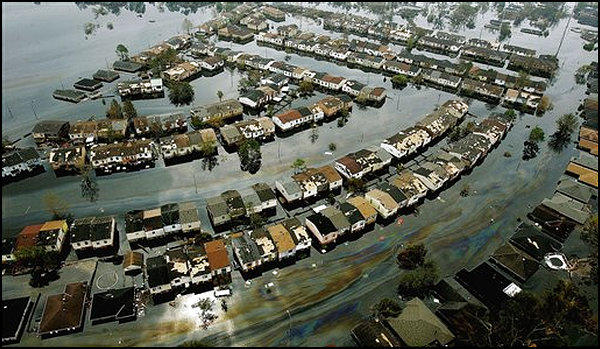
As the fallout from the most costly hurricane ever to hit America's shores continues, most folks aren't paying attention to whats around the corner. Katrina was merely the opening act in a long play (season) that could be the most intense the Gulf Coast has seen or experienced. For a city that celebrated past storms by throwing a party, the idea of a another category 3 or 4 storm hitting the region is far from everyone's mind in the fog of recovering from Katrina.
Dr. William Gray, professor of atmospheric science at Colorado State Univeristy in Fort Collins, has for years been tracking the hurricane activity worldwide with an emphasis on the Atlantic region. He has pioneered hurricane forcasting. So, after Katrina I thought it might be a good idea to read his annual forcast for this year's hurricane season. The bad news: the Caribbean is getting torn up. Here are some fast facts Gray points out in his forcast:
Information obtained through 31 August 2005 shows that we have already experienced 110 percent of the average full season Net Tropical Cyclone (NTC)4 activity. In an average year, 33 percent of the seasonal average NTC of 100 occurs before the end of August. We expect that by the time the 2005 hurricane season is over, we will witness seasonal tropical cyclone activity at near record levels.
The most intriging part of Gray's Report? He doesn't blame the increased storm activity on global warming. In fact he denounces it...
Many individuals have queried whether the unprecedented landfall of four destructive hurricanes in a seven-week period during August-September 2004 and the landfall of two more major hurricanes in the early part of the 2005 season is related in any way to human-induced climate changes. There is no evidence that this is the case. If global warming were the cause of the increase in United States hurricane landfalls in 2004 and 2005 and the overall increase in Atlantic basin major hurricane activity of the past eleven years (1995-2005), one would expect to see an increase in tropical cyclone activity in the other storm basins as well (ie., West Pacific, East Pacific, Indian Ocean, etc.). This has not occurred. When tropical cyclones worldwide are summed, there has actually been a slight decrease since 1995. In addition, it has been well-documented that the measured global warming during the 25-year period of 1970-1994 was accompanied by a downturn in Atlantic basin major hurricane activity over what was experienced during the 1930s through the 1960s.
Well, shucks. So we aren't getting abnormally high amount of hurricanes but the ones we do get are more intense than ever before? The Pew Center on Global Climate Change seems to think there may be a connection between global warming and high intensity hurricanes, although they are unwilling to confirm it as fact.
So for now it looks like the jury is still officially out on a direct link between intense hurricanes and global warming, although a majority of scientists do say, rather confidently, that increasing global temperatures will result in more intense storms (but not more frequent storms) and they will be more destructive as more coastlines are developed and populations increase.
I think we have to restore order and life in New Orleans, but maybe we could do better NOT developing New Orleans anymore than it has to be? After Dennis Hastert's comments yesterday who knows what people think. Regardless, we're in for an interesting September and October.
Monday, August 29, 2005
A Drop in the Barrel
Well, I'm all for baby steps when in comes to progress, but anything less than that and I think it's time to re-think the strategies. Secretary of Transportation Norman Mineta, one of the few holdovers from the Clinton Administration, announced that sweeping new efficiency standards for SUVs and light trucks (and whats the difference there, btw?) would "save gas and headaches for American drivers at the pump." Hmm...what drivers is Norman talking about? Surely not the 13 mpg Lincoln Navigators or 10 mpg H2 Hummers (Ooo...unless you have the new H3 in which case you get 15 mpg)?
The new plan would mandate that vehicles under manufacture between 2008 and 2011 would have to, on average, get 1.8 mpg more than they do now, which puts the overall average around 24 mpg. The Post's editorial for today says the rest:
So much for baby steps. This feels like we're on the treadmill to denial. Neil Armstrong, a man famous for his steps, would be appalled.
The new plan would mandate that vehicles under manufacture between 2008 and 2011 would have to, on average, get 1.8 mpg more than they do now, which puts the overall average around 24 mpg. The Post's editorial for today says the rest:
The administration estimates that this change will save 10 billion gallons of gasoline over about 15 years. This amounts to a total of about 25 days of consumption under current trends -- a disappointing drop in the barrel.When automotive fuel efficiency standards were introduced in 1975, the looser rules for so-called non-passenger vehicles -- a category that, believe it or not, has been interpreted to include minivans, SUVs and even some cars -- weren't all that important: These vehicles accounted for less than 20 percent of the market. Now SUVs and other gas-guzzling behemoths make up more than half of automotive sales.
So much for baby steps. This feels like we're on the treadmill to denial. Neil Armstrong, a man famous for his steps, would be appalled.
Friday, August 26, 2005
European Nature
You know, I really have to love the Washington Times. For one of the more conservative-leaning papers out there they really do try to cover "liberal" issues in a more moderate manner. So, they've posted a UPI story covering the recent natural disasters that have hit parts of Europe (fires in Portugal, flooding in Germany and an region-wide heat wave that marks as one of the highest in decades.
The piece goes on to quote scientists who say that, "The tendency is that in Europe, the temperatures will rise on average, which could mean more heat waves and heavy rainfalls."
Followed by, "I don't think we can stop that trend anytime soon."
I think my favorite part about this little article is that no where do they mention global warming. Why is no one even mentioning this as an "outlandish" reason for the ridiculous weather patterns we're seeing in Europe? Has no one learned?
Whats more, the article is written as if to say the weather in Europe doesn't affect the weather in the United States. Unfortunately it does and a to a great degree. Its not like the U.S. has been having a cooler than normal summer. Parts of the east coast are actually having periodic droughts! For only the third time in 55 years (the two other times were both after 2001) New York State was close to being "overtapped" because no rain fell. Chicago would look like the Sahara if it wasn't for the flood of water that fell from the sky two weeks ago and many of the agricultural lands of the central midwest are struggling to keep crops alive. And how about those hurricanes? To me, it doesn't sound like Europe is the only continent experiencing odd weather. Whaddya say we ALL start talking about global warming a little more seriously.
The piece goes on to quote scientists who say that, "The tendency is that in Europe, the temperatures will rise on average, which could mean more heat waves and heavy rainfalls."
Followed by, "I don't think we can stop that trend anytime soon."
I think my favorite part about this little article is that no where do they mention global warming. Why is no one even mentioning this as an "outlandish" reason for the ridiculous weather patterns we're seeing in Europe? Has no one learned?
Whats more, the article is written as if to say the weather in Europe doesn't affect the weather in the United States. Unfortunately it does and a to a great degree. Its not like the U.S. has been having a cooler than normal summer. Parts of the east coast are actually having periodic droughts! For only the third time in 55 years (the two other times were both after 2001) New York State was close to being "overtapped" because no rain fell. Chicago would look like the Sahara if it wasn't for the flood of water that fell from the sky two weeks ago and many of the agricultural lands of the central midwest are struggling to keep crops alive. And how about those hurricanes? To me, it doesn't sound like Europe is the only continent experiencing odd weather. Whaddya say we ALL start talking about global warming a little more seriously.
Thursday, August 25, 2005
India Bans Plastic Bags
Well, it's official: India is starting to ban plastic bags. The government of western Maharashtra State banned the manufacture, sale and use of plastic bags due to the massive clogging of any and all drainage systems during monsoon flooding. Bombay (Mumbai) residents were the first to chastize the government for its slow response after record rains hit the city this year, paralyzing the country's financial and entertainment capital. The choked drainage systems were unable to flush out the majority of water that fell in the state and helped cause debilitating landslides that killed over 1,000 people. To think that plastic bags could be responsible for so much damage.
Use of plastic bags world wide is growing. Each year between 500 - 1 billion plastic bags are used and thrown away. Thats fine if you have systems that are in place to gather them up (well, most of them anyway...I'm sure we've all seen our fair share of plastic bags dancing seductively through our city streets, backyards and favorite state parks). But most non-western countries don't have a system in place to pickup after themselves, much less the ability to recycle them. Many, like India, do not have standardized garbage pickup and thus, people just chuck the plastic onto the ground and that is that.
Is paper better? Not much. According to the American Forest and Paper Association, the U.S. used more than 10 billion paper grocery bags in 1999 requiring more than 14 million trees to be chopped down. Thats just for grocery bags. Factor in the hundreds of thousands daily newspapers, weekly magazines, computer paper and suddenly we've got quite a number of "non-vertical timber."
For a good intro into the background of paper vs. plastic checkout the Institute for Lifecycle Environmental Assesment. Who knew that it takes almost twice the amount of energy to make 1 plastic bag versus 2 paper?
Use of plastic bags world wide is growing. Each year between 500 - 1 billion plastic bags are used and thrown away. Thats fine if you have systems that are in place to gather them up (well, most of them anyway...I'm sure we've all seen our fair share of plastic bags dancing seductively through our city streets, backyards and favorite state parks). But most non-western countries don't have a system in place to pickup after themselves, much less the ability to recycle them. Many, like India, do not have standardized garbage pickup and thus, people just chuck the plastic onto the ground and that is that.
Is paper better? Not much. According to the American Forest and Paper Association, the U.S. used more than 10 billion paper grocery bags in 1999 requiring more than 14 million trees to be chopped down. Thats just for grocery bags. Factor in the hundreds of thousands daily newspapers, weekly magazines, computer paper and suddenly we've got quite a number of "non-vertical timber."
For a good intro into the background of paper vs. plastic checkout the Institute for Lifecycle Environmental Assesment. Who knew that it takes almost twice the amount of energy to make 1 plastic bag versus 2 paper?
Wednesday, August 24, 2005
Sheehan Returns
Cindy Sheehan returned to Crawford, TX this afternoon after spending a week caring for her mother who suffered a stroke last week in Los Angeles. Many folks say her presence is vital to keep the emotion behind it all intact. I could not disagree more.
After spending a week there and meeting the other families at Camp Casey it became apparent that there was much more to this than Cindy Sheehan. The media glommed onto Cindy because the media needs a hero, an individual, a person to attach to. What they don't know is that there area heroes all around them whether they be Vietnam Veterans, Iraq War Veterans or any of the other veterans groups that are there simply asking the President for an explanation. What they don' t know is that there are thousands of mothers like Cindy who have lost a son or daughter in this war. And most of America wants an explanation. And no matter how many times the Prez goes around the country throwing Band-Aids on his Iraq war policy, his approval ratings continue to plummet.
So you see, its not about Cindy Sheehan. Its about the truth. Its about integrity. Bush says he knows what these words mean, but he hasn't shown us he knows how to express them.
After spending a week there and meeting the other families at Camp Casey it became apparent that there was much more to this than Cindy Sheehan. The media glommed onto Cindy because the media needs a hero, an individual, a person to attach to. What they don't know is that there area heroes all around them whether they be Vietnam Veterans, Iraq War Veterans or any of the other veterans groups that are there simply asking the President for an explanation. What they don' t know is that there are thousands of mothers like Cindy who have lost a son or daughter in this war. And most of America wants an explanation. And no matter how many times the Prez goes around the country throwing Band-Aids on his Iraq war policy, his approval ratings continue to plummet.
So you see, its not about Cindy Sheehan. Its about the truth. Its about integrity. Bush says he knows what these words mean, but he hasn't shown us he knows how to express them.
Niger Food Crisis
Kofi Annan and his wife Nane went to Niger as a show of solidarity with a country that is going through the one of the worst food shortages in over 35 years. Crops were devastated a year ago after drought and locusts provided two knock out blows to the entire Niger harvest. The next harvest is expected to be in late September. Until then nearly 2 million people must survive on aide from outside.
Ok, so whats the holdup? Yesterday, the international humanitarian organization Doctors Without Borders (Medecins Sans Frontieres) berated the United Nations for acting too slowly to help stem the desperate need of food and nourishment. Annan called the claim, "unfortunate." Well, I gotta say now is not the time to be playing "he said, she said." Annan then urged other humanitarian organizations to join together to help the starving people of Niger. Seems the U.N. is getting too slow for its own good. Or maybe its just politics.
Regardless, a couple million women and children are waiting on a bite to eat and the most powerful coalition of nations is dragging its feet. It's not like this is a war...these people just need food.
Ok, so whats the holdup? Yesterday, the international humanitarian organization Doctors Without Borders (Medecins Sans Frontieres) berated the United Nations for acting too slowly to help stem the desperate need of food and nourishment. Annan called the claim, "unfortunate." Well, I gotta say now is not the time to be playing "he said, she said." Annan then urged other humanitarian organizations to join together to help the starving people of Niger. Seems the U.N. is getting too slow for its own good. Or maybe its just politics.
Regardless, a couple million women and children are waiting on a bite to eat and the most powerful coalition of nations is dragging its feet. It's not like this is a war...these people just need food.
Friday, August 19, 2005
Crawford and Back
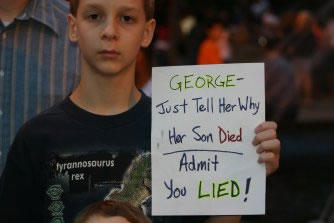
So as soon as I had posted the previous story on Cindy Sheehan, I was recruited to head down there and begin establishing an online presence for the quickly forming community that sprung up around her. For the first day I was posting to Joe Trippi's blog and then quickly started Crawford Update. The overall website established for Cindy (Meet With Cindy was receiving over 3 million hits a day for the first 4 days. Traffic has died down a bit now but still the blog gets thousands every day checking out the material being posted. To the left, one of my fave pics from the 40,000 vigils America put on for Cindy last Wednesday.
I had to leave on Wednesday morning to come back home and get plugging away on my work with Rainforest Action Network. It was a week of activism and excitement. Cindy is a pretty amazing woman. She is standing up and demanding answers. Something I wish more people would do. Also see my diary on the Kos for some great personal stories on who all is gathering in Crawford.
UPDATE: My last-minute interview with EchoRadio on Tuesday evening is up now as well.
Take a listen.
Thursday, August 11, 2005
Cindy Sheehan Brings the Fight to Crawford
Developing story out of Crawford Texas. Cindy Sheehan, the mother of fallen soldier Casey Sheehan continues to challenge Whore-Hay Bush Jr. only this time she's bravely brought the fight to the President's vacation home. Sitting outside "the ranch" while Whore-Hay enjoys a few weeks off from being the most powerful man in the world, Sheehan is grabbing press attention as her compelling story spreads across news desks around the country. It doesn't get much more American than this. A woman, disagreeing with the President's explanation and justification for the war in Iraq and the needless death of thousands of American GI's, has brought the fight to the President and is peaceably staging a sit-in protest outside his ranch. The Washington Post and LA Times both ran stories on Cindy today.
JoeTrippi.com and EchoRadio both have the podcast of a conference call with Sheehan and a corps group of bloggers. Apparently Cindy has been told that she "might get hit by a car" by the Secret Service multiple times which has begun to feel more like a "threat" than a "warning." Let's hope the SS isn't just trying to pressure Cindy to leave Crawford. See the Post's coverage of the call...
Many people and press are on their way down to Crawford to join the sit-in with the goal of getting Cindy into a meeting with President Whore-Hay.
JoeTrippi.com and EchoRadio both have the podcast of a conference call with Sheehan and a corps group of bloggers. Apparently Cindy has been told that she "might get hit by a car" by the Secret Service multiple times which has begun to feel more like a "threat" than a "warning." Let's hope the SS isn't just trying to pressure Cindy to leave Crawford. See the Post's coverage of the call...
Many people and press are on their way down to Crawford to join the sit-in with the goal of getting Cindy into a meeting with President Whore-Hay.
Oil Hits $66 a barrel
Black gold continues to hit record highs...
Refinery strains, concerns over Iran and recent forecasts.
Refinery strains, concerns over Iran and recent forecasts.
Thursday, August 04, 2005
Gambling for Water
Building off the previous post concerning water usage in the southwest, a great article in the BBC this morning chirped yet another warning to the country's fastest growing region: You're drying up. Fast.
As Mark Twain said, "Whiskey is for drinking, and water is fighting." Seems the desert southwest could be the Cesar's Main Event for some heavy blows in the coming years as California, Nevada, Arizona and New Mexico duke it out. Whats frightening in all of this is the fact that Las Vegas is one of the nation's fastest growing cities (6,000 people per month). But to the typical American tourist it's become commonplace to see 50 foot fountains of water and pools in every backyard amidst one of the world's driest climates. Talk about a man-made faux-paradise. I mean c'mon...its a freakin desert.
LV consumes over 190 gallons of water per person, per day. 30% of that is used outside, watering lawns and other shrubbery that otherwise wouldn't be there. To compare, Los Angeles uses approx. 162 gallons per person per day. New York City, after a 12 year plan to conserve water in the region has shrunk to 155 gallons. Austin, Texas, also dropped from 221 gallons to a respectable 116 gallons after a 15 year focus on water conservation.
I remember flying over Scottsdale, AZ a few years ago and seeing miles of dry brown desert and then all of the sudden, like a line drawn in the sand, neighborhoods of blue swimming pools and green backyards. The bottom line is water is a finite resource and we're treating it like it's infinite. Whats more, water wars between farmers (the ones growing the food for Las Vegas and many other southwest cities) and urbanites have been brewing for decades and are getting close to boiling over. They are vociferously fighting a bill that would bring a $5 billion pipeline from central Nevada directly to LV leaving little, if any, water for agriculture. So whats more important to you? Food or the casino fountains and pools that dot the desert landscape?
As Mark Twain said, "Whiskey is for drinking, and water is fighting." Seems the desert southwest could be the Cesar's Main Event for some heavy blows in the coming years as California, Nevada, Arizona and New Mexico duke it out. Whats frightening in all of this is the fact that Las Vegas is one of the nation's fastest growing cities (6,000 people per month). But to the typical American tourist it's become commonplace to see 50 foot fountains of water and pools in every backyard amidst one of the world's driest climates. Talk about a man-made faux-paradise. I mean c'mon...its a freakin desert.
LV consumes over 190 gallons of water per person, per day. 30% of that is used outside, watering lawns and other shrubbery that otherwise wouldn't be there. To compare, Los Angeles uses approx. 162 gallons per person per day. New York City, after a 12 year plan to conserve water in the region has shrunk to 155 gallons. Austin, Texas, also dropped from 221 gallons to a respectable 116 gallons after a 15 year focus on water conservation.
I remember flying over Scottsdale, AZ a few years ago and seeing miles of dry brown desert and then all of the sudden, like a line drawn in the sand, neighborhoods of blue swimming pools and green backyards. The bottom line is water is a finite resource and we're treating it like it's infinite. Whats more, water wars between farmers (the ones growing the food for Las Vegas and many other southwest cities) and urbanites have been brewing for decades and are getting close to boiling over. They are vociferously fighting a bill that would bring a $5 billion pipeline from central Nevada directly to LV leaving little, if any, water for agriculture. So whats more important to you? Food or the casino fountains and pools that dot the desert landscape?
Sunday, July 24, 2005
Remembering Hetch Hetchy
The SF Chronicle reports on the rebirth of a century-old issue: draining Hetch Hetchy Valley and bringing back one of America's most striking natural wonders. The fight that started over 100 years ago in 1903 revolves around a continuing debate between conservation and development and preserving our wilderness areas. Heralded by American naturalist John Muir as, "one of Nature's rarest and most precious mountain temples," Hetchy Hetchy was largely unknown to the American public (as the idea of conservation and National Parks in general were just beginning to evolve in the national conscience)until many years after the valley had been inundated. This prompted the NY Times to write, "The American people have been whipped in the Hetch Hetchy fight," upon authorization of the O'Shaunessey Dam by the U.S. Congress on December 6, 1913.
Gov. Schwarzenegger has asked for a report from the California Department of Water Resources on the possibility of draining the Hetch Hetchy Valley and re-establishing one of the wonders within Yosemite National Park. According to the CDWR doing so would not limit the supply of water to San Francisco and the Bay Area and wouldn't cause any significant loss of electric power. The downside: depending more on fossil fuels for power (like coal and oil), loss of quality water (h20 from the High Sierras is some of the cleanest in the country), and no more gurantee when severe water shortages hit one of the driest regions in North America.
Once again the discussion comes back to the question, "How much is wilderness worth to us?" Seems to me a simple answer is putting forward some serious conservation measures. Maybe its time for California and the rest of the semi-arid desert west to come to grips with the fact that living in such an environment will require some sacrifices on their part and in the end those sacrifices will enable natural wonders like Hetch Hetchy to remain.
Gov. Schwarzenegger has asked for a report from the California Department of Water Resources on the possibility of draining the Hetch Hetchy Valley and re-establishing one of the wonders within Yosemite National Park. According to the CDWR doing so would not limit the supply of water to San Francisco and the Bay Area and wouldn't cause any significant loss of electric power. The downside: depending more on fossil fuels for power (like coal and oil), loss of quality water (h20 from the High Sierras is some of the cleanest in the country), and no more gurantee when severe water shortages hit one of the driest regions in North America.
Once again the discussion comes back to the question, "How much is wilderness worth to us?" Seems to me a simple answer is putting forward some serious conservation measures. Maybe its time for California and the rest of the semi-arid desert west to come to grips with the fact that living in such an environment will require some sacrifices on their part and in the end those sacrifices will enable natural wonders like Hetch Hetchy to remain.
Sunday, July 17, 2005
The Un-Hybrid
Matthew Wald of the NY Times writes about how today's new hybrid vehicles aren't as green as they seem. Car companies like Honda have started "hybridizing for performance," meaning that the new hybrids get about the same gas mileage as their non-hybrid sisters in exchange for slightly faster acceleration and pickup. What might be questionable in all of this (besides the fact that the companies are selling the cars as "green turbochargers") is that the buyers of the new Hybrid V6 Accord (or the Lexus RX400h, Toyota Highlander, and Honda Civic)still get the $600-$1300 tax rebate at the end of the year, even though they are burning just as much gas as their neighbor driving the standard Honda Accord or Civic. Not sure Joe Merica will be excited about the fact that vehicles targeting upper-middle class motorists is giving out questionable tax rebates for a car that chews through just as much gas as anything else on the market but happens to get off the line a few seconds quicker. The EPA ranks the vehicles as getting a mile per gallon more than the standard models but these rankings are always considered inaccurate because they don't reflect the way in which cars are actually driven.
One line from Wald's article sums it up nicely:
"Hybrid technology seems to be heading the way of earlier technologies, which got more work out of a gallon of gasoline, like four valves per cylinder and variable valve timing, that have been used in the end to make cars accelerate faster, rather than to hold them steady in performance and to cut fuel consumption."
Anyone else worried our hybrid euphoria could crash before it actually takes off?
One line from Wald's article sums it up nicely:
"Hybrid technology seems to be heading the way of earlier technologies, which got more work out of a gallon of gasoline, like four valves per cylinder and variable valve timing, that have been used in the end to make cars accelerate faster, rather than to hold them steady in performance and to cut fuel consumption."
Anyone else worried our hybrid euphoria could crash before it actually takes off?
Tuesday, July 05, 2005
Republicans Bad for Business?
In a strange twist of events, the Chinese government is criticizing the U.S. Congress for "erecting barriers" in the monumental deal between China's energy firm CNOOC and the American oil company Unocal. Congress has urged the White House to block the deal under the banner of "national security." Odd that the GOP is now hankering to control business. What happened to free-trade and beauty of private enterprise? Apparently, those ideals are only applicable for certain situations.
The truth of the matter is, in the forum of small business vs. the federal government, the Feds usually win. But not in a competitive, "I have more money than you" sense. It is inherently impossible for all small businesses to work easily and in accord with the federal government. To help this relationship, Congress has always passed special rules and procedures to help these businesses navigate the federal marketplace. Yet, we are now witnessing Congress urging a sitting president to effectively control the outcome of a international business deal? Not sure i understand the national security threat either...unless they're talking about global warming which will increase dramatically if China becomes the American dream of two SUVs per family.
The truth of the matter is, in the forum of small business vs. the federal government, the Feds usually win. But not in a competitive, "I have more money than you" sense. It is inherently impossible for all small businesses to work easily and in accord with the federal government. To help this relationship, Congress has always passed special rules and procedures to help these businesses navigate the federal marketplace. Yet, we are now witnessing Congress urging a sitting president to effectively control the outcome of a international business deal? Not sure i understand the national security threat either...unless they're talking about global warming which will increase dramatically if China becomes the American dream of two SUVs per family.
Subscribe to:
Posts (Atom)